Searching for the RCIA meaning often leads to confusing acronyms, outdated parish flyers, and half-finished explanations. That gap leaves curious hearts stuck before they even ask their first real question. This guide closes that gap. Below, you will find a clear definition of the RCIA meaning, the exact steps of the process, and what your first year as a catechumen actually looks like.
What Does RCIA Mean? A Clear, Simple Definition
RCIA stands for the Rite of Christian Initiation of Adults. If you’ve ever typed “what is RCIA” into a search bar late at night, you’re already closer to an answer than you think.
In plain terms, the RCIA meaning describes a formation journey. The Catholic Church uses it to welcome adults who want to be baptized, confirmed, or fully received into the faith. It combines teaching, prayer, and community support into one guided path.
The process is not a single class or a one-time event. It unfolds in stages, each building on the one before it, until a person is ready to fully belong to the Church.
Once you grasp the RCIA meaning at this basic level, every other detail in this guide — the stages, the timeline, the sacraments — will click into place much faster.
RCIA Meaning in the Catholic Church: Where the Term Comes From
RCIA in the Catholic Church traces its roots to the early centuries of Christianity, when new believers spent months — sometimes years — learning the faith before baptism. That original model faded over time as infant baptism became the norm across most Catholic families.
The Second Vatican Council (1962–1965) brought the practice back to life. Church leaders realized that adults coming to the faith later in life needed a structured, communal path, not just a quick set of lessons.
Here is a short timeline of how the process reached its current form:
- 1972 – Pope Paul VI approved the original Latin rite, Ordo Initiationis Christianae Adultorum.
- 1974 – The English translation was approved for use in the United States.
- 1986 – The U.S. Catholic Conference approved a combined ritual edition with national statutes.
- 2021 – The U.S. Conference of Catholic Bishops (USCCB) voted to rename the process OCIA.
- 2024 – New national statutes for the renamed process took full effect on December 1.
RCIA vs OCIA: Why the Name Changed (and What Stayed the Same)
Many people still search using the older term, so let’s settle that naming question directly. In November 2021, the USCCB approved a revised English translation of the ritual text and renamed the process from “Rite” to “Order.” The Vatican’s Dicastery for Divine Worship later confirmed the new edition, and revised national statutes took effect on December 1, 2024.
The word “Order” was chosen because it better reflects the original Latin and emphasizes that joining the Church is an ongoing journey, not a single fixed ceremony.
| Old Term | New Term | What Changed |
| RCIA (Rite) | OCIA (Order) | Name reflects an ongoing formation journey, not one event |
| Candidate | Inquirer, Catechumen, or Elect | Terms now match where a person stands in the process |
| RCIC (children’s version) | OCIC | Same update applied to the children’s adaptation |
The good news: the sacraments, the prayers, and the heart of the process did not change. Only the name and a few terms were updated, so the RCIA meaning you learned above still applies under its new title. Most parishes still use “RCIA” in everyday conversation, even while their official paperwork says OCIA.
Who Should Join RCIA? Three Groups the Church Welcomes
Most RCIA programs are built for three distinct groups of people, and understanding the RCIA meaning behind each category makes the whole process much clearer.
- Unbaptized adults who have never received any form of Christian baptism.
- Baptized Christians from other denominations who want full communion with the Catholic Church.
- Baptized Catholics who never received First Communion or Confirmation as children.
Anyone ready to start this journey can join at almost any point in the year, since most parishes hold an ongoing inquiry period before the formal stages begin.
The Four Stages of RCIA: A Complete Breakdown
Each stage follows a set order, marked by its own rite at Mass, and each one deepens the RCIA meaning a little further. Here is exactly what happens at each point:
| Stage | Also Called | What Happens | Typical Length |
| 1. Inquiry | Precatechumenate | Open questions, casual meetings, no commitment required | Weeks to a few months |
| 2. Catechumenate | Formation Period | Deeper study of Scripture and Church teaching, weekly sessions | Several months to a year |
| 3. Purification & Enlightenment | Lenten Period | Final prayerful preparation before the sacraments | The 40 days of Lent |
| 4. Mystagogy | Post-Easter Reflection | New Catholics reflect on their experience and deepen parish life | Roughly 50 days after Easter |
Each stage ends with a short ceremony at Mass, so the whole parish community walks the journey alongside the person preparing to join.
How Long Does RCIA Take? A Realistic Timeline
So what’s a realistic timeline from the first meeting to full membership? For most people, the answer falls between six months and one full year, with the final sacraments celebrated at the Easter Vigil.
A few factors can shift that timeline:
- Your starting point (unbaptized adults typically need more formation time than baptized Catholics returning to complete their sacraments).
- How often your parish holds sessions — weekly is standard, but some meet biweekly.
- Personal readiness, since the parish team wants genuine understanding, not just attendance.
- Local diocesan guidelines, which can set a minimum length for the catechumenate.
If you start in the fall, you can expect to reach the Easter Vigil the following spring, which is the traditional night for receiving the sacraments.
What Happens Inside RCIA Classes Each Week
These sessions are far less formal than a school lecture. Most run 60 to 90 minutes and follow a simple, welcoming rhythm.
A typical week usually includes:
- A short opening prayer or Scripture reading.
- A discussion led by a priest, deacon, or trained catechist on a specific topic (sacraments, the Mass, Church history, moral teaching).
- Open time for questions — nothing is off-limits.
- Personal reflection or a small take-home reading.
- Occasional shared meals or social time to build community.
The tone stays conversational. Leaders expect questions, doubts, and even disagreement, because real formation grows out of honest dialogue.
The Role of an RCIA Sponsor: Why You Need One
Every participant works alongside a sponsor, a practicing Catholic who walks the journey with them personally. A sponsor is not the same as a godparent, though the same person can sometimes fill both roles later.
A good sponsor typically:
- Attends sessions alongside the participant when possible.
- Answers everyday questions about Catholic life and practice.
- Prays for and with the person preparing for the sacraments.
- Stands beside them during key rites at Mass.
Having a steady, supportive sponsor often makes the difference between a person who finishes the journey confidently and one who drifts away halfway through.
RCIA Requirements: What You Need Before You Start
These expectations are simpler than most people expect, because the RCIA meaning centers on sincerity and openness far more than paperwork.
Here is what parishes generally ask for:
- A genuine desire to learn about the Catholic faith.
- Willingness to attend sessions consistently.
- A baptismal certificate, if you were baptized in another Christian tradition.
- An honest conversation about marital status, since certain situations (such as a prior marriage) may need review under Church law before the sacraments are celebrated.
- A sponsor, arranged with help from the parish if you don’t already know one.
None of these requirements are meant to create obstacles. They exist so the parish can guide each person through the right path for their situation.
RCIA Sacraments: What You Receive at the Easter Vigil
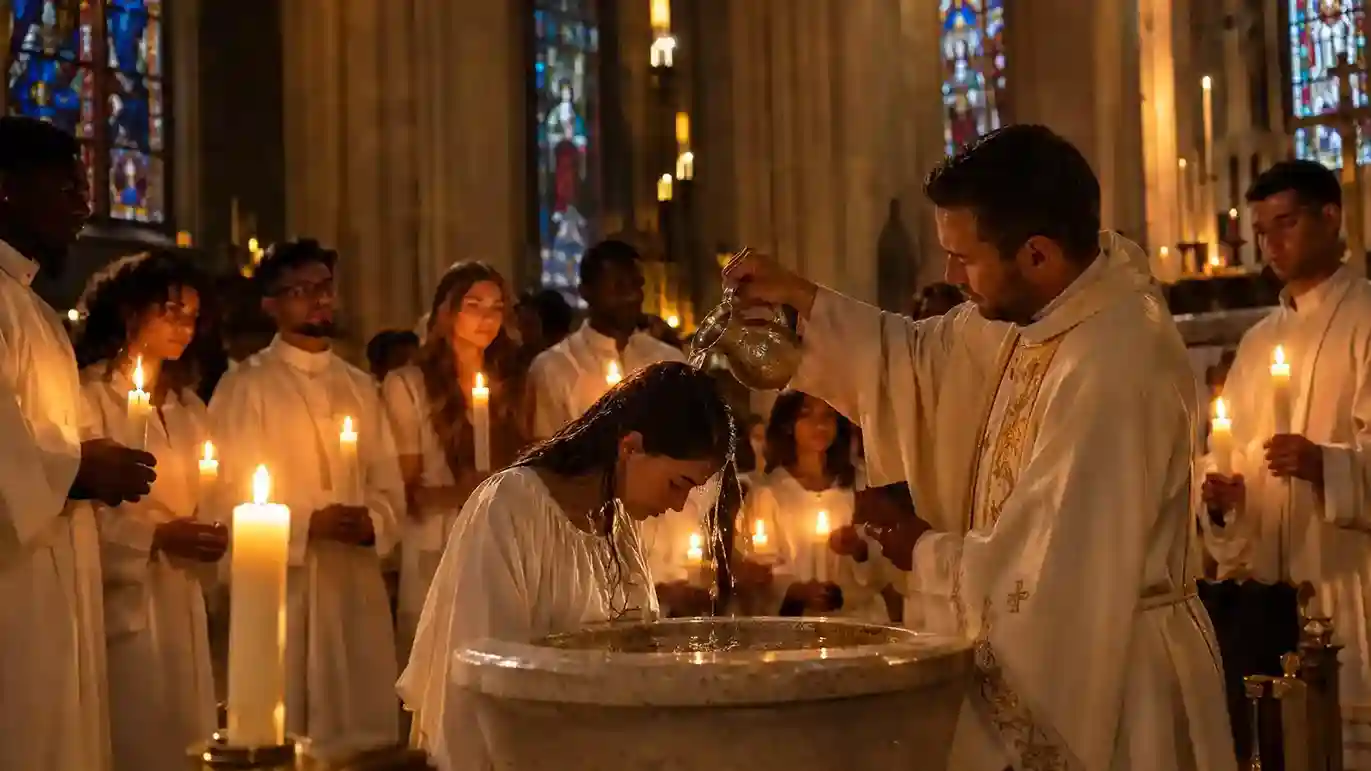
These sacraments mark the finish line of the entire journey, and the full RCIA meaning comes into focus the night they are celebrated. Depending on your starting point, you may receive one, two, or all three sacraments of initiation on the same night.
| Sacrament | What It Does | Who Receives It |
| Baptism | Washes away sin and brings new life in Christ | Adults who were never baptized |
| Confirmation | Strengthens the gifts of the Holy Spirit | Most participants, regardless of starting point |
| Eucharist (First Communion) | Full sharing in the Body and Blood of Christ | All who complete the process |
For someone experiencing adult baptism in the Catholic Church for the first time, all three sacraments are typically celebrated together at the same Easter Vigil Mass — a moment parishes describe as one of the most joyful nights of their liturgical year.
Is RCIA Right for You? Understanding the RCIA Process Compared to Other Options
Some people wonder if there’s a faster path than this full formation journey. A handful of casual conversations with a priest can answer basic questions, but they cannot replace the structured formation the Church has used for centuries.
The Catholic conversion process exists precisely because faith formed through community, study, and prayer tends to last. Skipping steps to save time often leaves gaps that surface years later, when a deeper question about the faith goes unanswered.
If you want a real, lasting foundation rather than a quick overview, the full process remains the better investment of your time.
Common Challenges During RCIA and How to Handle Them
Every journey has rough patches, and RCIA is no exception. Knowing what to expect makes these moments far easier to push through.
- Scheduling conflicts — Talk to your coordinator early; most parishes offer flexible catch-up options.
- Difficult doctrine questions — Bring them straight to your session leader instead of searching for answers alone online.
- Family pushback — Share your reasons calmly and invite loved ones to ask honest questions.
- Feeling behind other participants — Everyone starts from a different place; steady effort matters more than speed.
Persistence through these moments almost always deepens commitment rather than weakening it.
Benefits of Completing RCIA: Why It’s Worth the Journey
Finishing the process brings far more than a certificate or a date on a calendar — this is where the RCIA meaning truly comes alive. Participants consistently describe a few lasting benefits:
- A clear, confident understanding of Catholic belief and practice.
- A built-in community of sponsors, fellow catechumens, and parish members.
- Full access to the sacraments, including ongoing Confession and Communion.
- A stronger personal relationship with God, built through months of study and prayer.
Many new Catholics say the friendships formed during these weekly sessions last well beyond their reception into the Church.
FAQs
What does RCIA mean in simple words?
The RCIA meaning, in plain language, is the Catholic Church’s structured process for welcoming adults into full membership.
It combines teaching, prayer, and mentorship, guiding participants from initial curiosity to the sacraments of Baptism, Confirmation, and Eucharist.
Is RCIA the same as OCIA?
Yes. OCIA (Order of Christian Initiation of Adults) is the updated official name for the same process previously called RCIA.
The USCCB approved this name change in 2021, and revised national statutes took full effect in December 2024. The sacraments and core structure remain unchanged.
How long does RCIA last from start to finish?
Most participants complete the process in six months to a full year, finishing at the Easter Vigil.
Exact length depends on your parish’s schedule, your starting point, and diocesan guidelines for the length of formation.
Can I leave RCIA before Easter if I change my mind?
Yes. Participation is completely voluntary at every stage, and no one is obligated to continue or receive the sacraments.
Many parishes actually encourage this openness, since genuine conviction matters more than simply finishing a program.
Do I have to pay to join RCIA?
Most parishes offer the program free of charge, though some ask for a small fee to cover workbooks or materials.
Cost should never be a barrier — speak with your parish office if finances are a concern, since exceptions are common.
What is the difference between a catechumen and a candidate in RCIA?
A catechumen is someone who has never been baptized and is preparing for Baptism, Confirmation, and Eucharist together.
A candidate is someone already baptized (Catholic or another Christian tradition) who is preparing to complete their sacraments or enter full communion.
Final Thoughts: Take the Next Step With Confidence
Understanding the RCIA meaning is only the first step of a much bigger, richer journey. The process asks for patience and honesty, but it rewards both with a clear, confident faith and a genuine community around you.
If you feel ready to explore RCIA further, reach out to your local parish office this week and ask about their next inquiry session. That single phone call or email often marks the true beginning of the whole story.