You keep seeing that palm-shaped charm on necklaces, walls, and phone cases, but no one ever explains what it actually stands for. Searching for a straight answer usually leads to ten different stories that all contradict each other. This guide fixes that. Below, you’ll find the real hamsa meaning, backed by history, religion, and how people use it today.
What Does Hamsa Meaning Stand For? (Quick Answer)
The hamsa meaning centers on one idea: protection. Hamsa is a palm-shaped amulet, usually shown with five fingers, that people have worn or displayed for centuries to guard against harm, envy, and the “evil eye.” The word itself comes from the Arabic khamsa and the Hebrew chamesh, both of which mean “five,” a direct nod to the five fingers on the hand.
Beyond protection, the hamsa symbol also represents blessing, strength, and good fortune. It shows up in Jewish, Islamic, Christian, and secular Middle Eastern traditions, each adding its own layer of meaning on top of that shared protective core.
The Origin and History of the Hamsa Hand
The hamsa hand predates every major religion that now uses it. Archaeologists trace open-hand amulets back to ancient Mesopotamia, where they appeared in carvings linked to the goddess Ishtar (also called Inanna), and to ancient Carthage in North Africa, where a similar hand symbol honored the goddess Tanit.
From there, the symbol traveled across trade routes into the wider Middle East and North Africa. Jewish and Muslim communities living side by side in Spain, Morocco, and the Levant each picked it up and folded it into their own customs. That shared history is exactly why the hamsa meaning today feels layered rather than owned by a single group.
Key historical touchpoints include:
- Ancient Mesopotamia — early open-hand carvings tied to goddess worship
- Phoenician and Carthaginian North Africa — hand symbols used as protective charms
- Medieval Spain (Al-Andalus) — the hamsa appears carved into the Alhambra fortress gate
- Post-1492 Sephardic migration — Jewish exiles carried the symbol into North Africa and the Ottoman Empire
- 20th-century Israel — the hamsa became a shared cultural emblem for both Jewish and Arab communities
Hamsa Meaning in Judaism: The Hand of Miriam
Within Judaism, the hamsa is often called the Hand of Miriam, named after Miriam, the sister of Moses and Aaron, who led the Israelite women in song after the crossing of the Red Sea. It also carries the title “Hand of God,” reflecting the biblical image of God’s “strong hand” guiding the Israelites out of Egypt.
Jewish households have hung hamsa amulets in doorways and worn them as jewelry for generations, often pairing the symbol with a Star of David or a Hebrew blessing for extra meaning. The number five reinforces this: it echoes the Five Books of the Torah and the Hebrew letter heh, one of the names associated with God.
This tradition is especially strong among Sephardic and Mizrahi Jewish communities, whose roots trace back to Spain, North Africa, and the wider Middle East.
Hamsa Meaning in Islam: The Hand of Fatima
In Islamic culture, the hamsa is widely known as the Hand of Fatima, honoring Fatima Zahra, the daughter of the Prophet Muhammad. She’s remembered for her patience, devotion, and inner strength, qualities the symbol is meant to reflect back onto the person who wears it.
The number five holds separate weight here too. It calls to mind the Five Pillars of Islam: the declaration of faith, daily prayer, charity, fasting during Ramadan, and pilgrimage to Mecca. Some Shia traditions instead connect the five fingers to the Five People of the Cloak, a reference to the Prophet’s family.
Across North Africa, the hamsa remains one of the most common protective symbols in everyday Muslim life, appearing on doorframes, in cars, and in jewelry passed down through families.
Hamsa Meaning in Christianity and Beyond
Christian communities in the Middle East, particularly in Lebanon and Egypt, have also adopted the hamsa, sometimes calling it the “Hand of Mary” after the Virgin Mary. Here, it represents maternal protection, purity, and strength, and it’s occasionally combined with a fish symbol, an early Christian marker of faith.
Outside organized religion, the hamsa has grown into a secular symbol of peace and shared heritage across the Middle East. Activists on both sides of regional conflicts have worn it precisely because its roots run through multiple faiths at once, making it a rare emblem that doesn’t belong to just one side.
The Evil Eye and Hamsa: How They Work Together
The evil eye is the belief that an envious or hostile stare can bring bad luck, illness, or misfortune to the person it’s aimed at. This idea shows up across Greek, Turkish, Middle Eastern, South Asian, and Latin American cultures, each with its own name for it: ayin hara in Hebrew, nazar in Arabic and Turkish, mati in Greek.
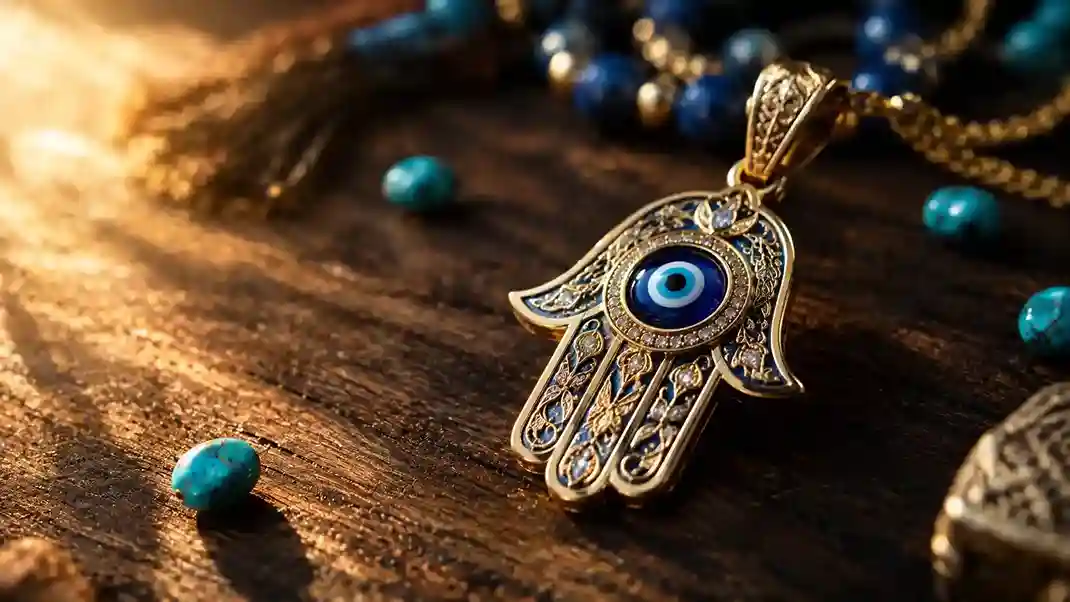
The hamsa hand and the evil eye charm are often confused for the same thing, but they’re not identical. The blue-and-white circular eye deflects a harmful gaze, while the hamsa acts as a broader shield against negativity, jealousy, and bad luck in general. Many designs combine both symbols into one piece, placing an eye directly in the center of the palm for double protection.
People wear the two together for a simple reason: layered protection feels stronger than relying on one symbol alone.
Hamsa Hand Up or Down? Orientation Meaning Explained
One question comes up constantly: should the fingers point up or down? There’s no single correct answer here, since interpretations shift by region and personal belief, but two common readings have become standard.
| Orientation | Common Meaning | Typical Use |
| Fingers pointing up | Active protection against the evil eye and negative energy | Necklaces worn close to the chest, entryway charms |
| Fingers pointing down | Openness to blessings, abundance, fertility, and good fortune flowing in | Bracelets, decorative wall pieces |
Neither direction is more “correct” than the other. Choose the orientation that matches what you want the piece to represent for you, whether that’s a shield against harm or an invitation for good things to arrive.
Types of Hamsa Symbols and Their Designs
Not every hamsa hand looks the same, and the design details often carry their own small meaning. Here’s a breakdown of the most common variations you’ll come across:
| Design Element | What It Typically Means |
| Symmetrical hamsa (two thumbs) | The most popular stylized version; purely symbolic rather than anatomical |
| Anatomical hamsa (one thumb, four fingers) | A more literal hand shape, common in older or handmade pieces |
| Eye in the palm | Direct evil-eye protection layered into the symbol |
| Fish motif | Common in Christian versions; represents faith and abundance |
| Star of David in the palm | Jewish identity paired with protection |
| Arabic calligraphy inscription | Often a Quranic verse or blessing for protection |
| Colored gemstones (blue, turquoise) | Reinforces the evil-eye connection, since blue is the traditional protective color |
Hamsa Necklace, Bracelet, and Jewelry Meaning
Jewelry is where most people first encounter the hamsa symbol, and the meaning stays consistent no matter the piece. A hamsa necklace worn near the heart is typically chosen for personal protection and daily reassurance. A hamsa bracelet, worn on the hand itself, is often picked as a subtle reminder to stay grounded and guarded through the day.
Materials matter less than intention here. You’ll find the symbol in sterling silver, gold, olive wood, and simple beaded string, and all of them carry the same underlying purpose. What changes is the gifting context: hamsa jewelry is commonly given for new babies, new homes, graduations, or anyone going through a rough patch, since the gesture itself is meant to say “may you be protected.”
Hamsa Tattoo Meaning: What It Symbolizes on Skin
A hamsa tattoo carries the same core symbolism as the jewelry version, protection, strength, and good fortune, but permanence adds a personal layer. People often choose this design after a difficult period, treating it as a lasting reminder of resilience rather than a passing trend.
Placement can shift the emphasis slightly:
- Wrist or hand — visible, everyday protection
- Back of the neck — a quieter, more private meaning
- Forearm or shoulder — room for added detail like an eye, lotus, or floral pattern
- Chest, over the heart — protection tied to emotional or spiritual matters
As with jewelry, orientation and added symbols (an eye, a flower, a mandala pattern) let people customize the meaning to fit their own story.
Hamsa Wall Hanging and Home Decor Meaning
Hanging a hamsa near a front door or above a bed follows the same logic as wearing one: it’s meant to filter out negative energy before it enters the home. This practice is especially common in Middle Eastern, North African, and Mediterranean households, where a hamsa is often the first decorative object placed in a new house.
Larger wall pieces tend to combine the hand with other protective elements, hanging beads, small bells, or an evil eye charm at the fingertips, to add visual weight and reinforce the intention behind the piece.
How to Cleanse and Set Intentions With Your Hamsa
Many people who wear or display a hamsa also follow a simple ritual to “activate” its meaning for them personally. None of this is required, but it’s a common practice worth knowing:
- Cleanse it — pass the piece through incense smoke, sunlight, or moonlight for a few minutes.
- Hold it and state your intention — protection, calm, confidence, whatever you’re focused on.
- Wear or place it deliberately — near your heart, by your front door, or on your dominant hand.
- Revisit the intention periodically — some people repeat this monthly or during a new moon.
This isn’t a religious requirement in any tradition; it’s simply a personal way people connect with the object rather than treating it as decoration alone.
Is It Okay to Wear a Hamsa If You’re Not Jewish or Muslim?
Yes, and this is one of the most searched questions around hamsa meaning. Because the symbol predates both religions and belongs to a shared regional history rather than one faith, wearing it is generally considered acceptable regardless of your background.
That said, a little awareness goes a long way. Knowing the history, rather than treating it as a random trendy charm, shows respect for the communities who’ve carried this symbol for centuries. If you’re buying one as a gift, mentioning its background makes the gesture land with more meaning.
Hamsa Meaning Quick Reference Table
| Aspect | Details |
| Core meaning | Protection, blessing, strength, good fortune |
| Word origin | Arabic khamsa / Hebrew chamesh, both meaning “five” |
| Jewish name | Hand of Miriam / Hand of God |
| Islamic name | Hand of Fatima |
| Christian name | Hand of Mary |
| Oldest traces | Ancient Mesopotamia and Phoenician North Africa |
| Main threat it guards against | The evil eye (ayin hara / nazar) |
| Fingers up | Active protection |
| Fingers down | Openness to blessings and abundance |
| Common materials | Silver, gold, olive wood, beads |
| National symbol status | Featured on Algeria’s national emblem |
FAQs
1. What does hamsa mean in one word?
Protection. Every cultural variation of the symbol, Jewish, Islamic, or Christian, shares this single core idea at its center.
2. Is hamsa a religious symbol?
It’s used across several religions, but it started as a regional folk symbol before Judaism, Islam, or Christianity adopted it, so it isn’t tied exclusively to one faith.
3. Which way should a hamsa face for protection?
Fingers pointing up is the interpretation most associated with active protection against negativity and the evil eye, though fingers pointing down (openness to blessings) is equally common and valid.
4. Is hamsa the same as the evil eye?
No. The evil eye is a separate belief and charm that deflects a harmful stare; the hamsa is a broader protective symbol. Many pieces combine both for layered protection.
5. Can anyone wear a hamsa hand, regardless of religion?
Yes. Because the symbol’s roots are shared across multiple cultures rather than owned by one, it’s widely considered appropriate for anyone to wear, especially when worn with an understanding of its history.
6. What does the eye in the center of a hamsa mean?
It represents direct protection against the evil eye, reinforcing the hand’s general protective purpose with a more specific symbol aimed at deflecting envious or harmful stares.
Bringing the Hamsa Meaning Into Your Own Life
The hamsa hand has carried the same promise for thousands of years: protection, strength, and good fortune for whoever holds it close. Whether you choose a necklace, a wall hanging, or a tattoo, you’re picking up a symbol with real weight behind it, not just a trend.
Now that you know the full hamsa meaning, pick the version that fits you, up or down, silver or gold, worn or displayed, and wear that history with intention.