“BB” appears next to a player’s name when you open a box score. No hit. No run. Just two letters. So what does BB mean in baseball? It stands for base on balls, better known as a walk. Fans who skip this stat miss half of a hitter’s story. This guide shows how walks happen, how scorers count them, and why front offices prize them.
What Does BB Mean in Baseball? The Short Answer
BB means base on balls. A batter earns one when the pitcher throws four balls during a single plate appearance. The batter then trots to first base without swinging at a hit.
The majority of fans just say “walk,” which is written as BB on scorecards, box scores, and stat sites.
Here is the quick version:
- For a hitter, BB counts the walks he drew.
- For a pitcher, BB counts the walks he allowed.
- For a team, BB shows how often its lineup or staff won or lost the strike-zone battle.
MLB’s own glossary uses the same definition: a walk is awarded after four pitches outside the strike zone (MLB Glossary: mlb.com/glossary/standard-stats/base-on-balls).
How a Walk Happens, Step by Step
A walk follows a simple count. The umpire calls each pitch a ball or a strike, and the count builds from there.
- The batter steps in with a 0-0 count.
- The pitcher throws. Each pitch outside the zone that the batter does not swing at becomes a ball.
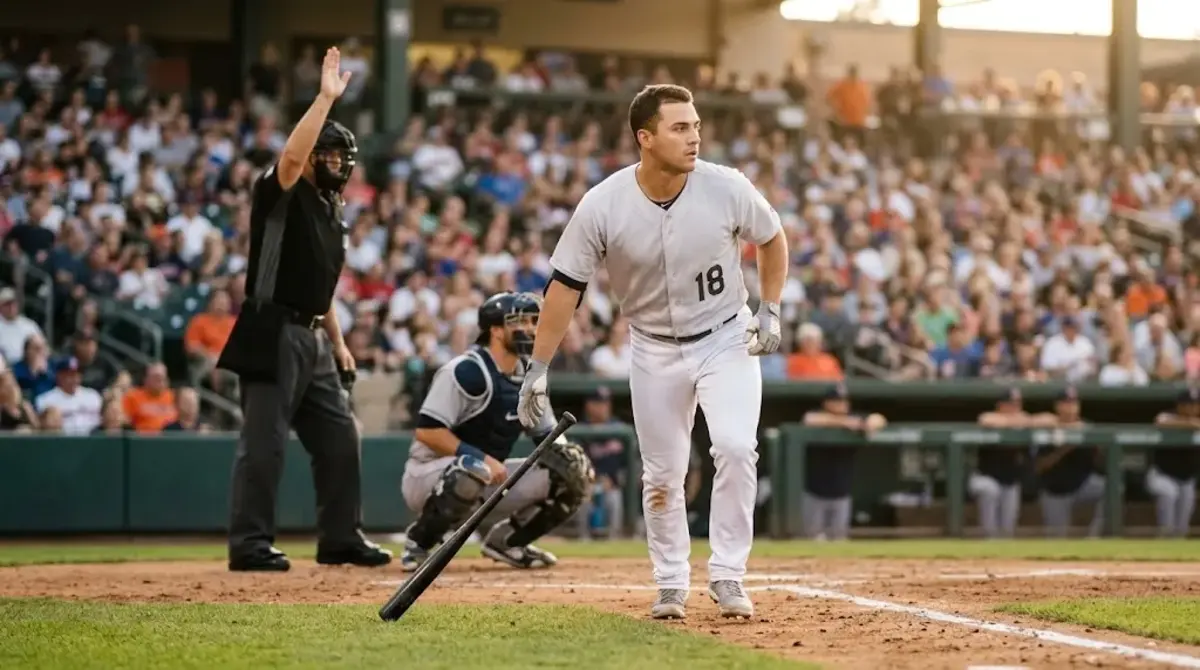
- Four balls end the at-bat. The count reads 4 balls, and the umpire waves the batter to first.
- Strikes can arrive along the way. Three strikes before the fourth ball means a strikeout instead.
The full count is 3-2. The next pitch decides the at-bat. A ball means a walk. A strike means a strikeout, unless the batter puts the ball in play.
A batter who walks must move to first base. Baseball’s rulebook treats the walk as an award, and runners advance only when the batter’s trip to first forces them (Official Baseball Rules, MLB: mlb.com/official-information/official-rules).
What Counts as a Ball?
A ball is any pitch that misses the strike zone and draws no swing. The strike zone runs from the batter’s knees to the midpoint between the shoulders and belt, over the width of home plate.
Umpires make this call, and judgment varies slightly from game to game. Hitters who read the zone well force pitchers to throw strikes. That skill carries a name: plate discipline.
A few pitches never count as balls:
- A strike occurs when a batter swings at a pitch and misses it.
- A foul ball adds a strike, unless the batter already has two.
- A pitch is not a ball if it strikes the hitter. It is a different award, covered below.
How Scorers Record BB in the Box Score and Scorebook
Scorekeepers write BB in the scorebook square when a batter walks. Box scores then add up the totals in a column labeled BB.
Two rules matter most:
- A walk is not an at-bat. The batter did not hit, field, or strike out, so his batting average stays untouched.
- A walk is a plate appearance. It counts toward every stat built on plate appearances, including on-base percentage.
On a bases-loaded walk, the runner on third scores. The batter receives an RBI for it, which surprises many new fans.
BB vs. IBB vs. HBP: Three Methods to Get First Without Getting Hit
Fans often mix up the three free passes. They look alike on the field, but the stat sheet separates them.
| Term | Full Name | How It Happens | Counts as BB? | Counts as an At-Bat? |
| BB | Base on balls | Pitcher throws four balls | Yes | No |
| IBB | Intentional base on balls | Manager orders a walk on purpose | Yes, and listed separately | No |
| HBP | Hit by pitch | Pitch strikes the batter outside the zone | No | No |
| K | Strikeout | Three strikes | No | Yes |
| H | Hit | Batter reaches base on a batted ball | No | Yes |
IBB is a subset of BB. If a player has 90 walks and 10 were intentional, his box score shows 90 BB, with 10 of them tagged IBB. HBP gets its own column, though it helps on-base percentage just like a walk.
The Intentional Walk: When Supervisors Select BB on Purpose
A manager may decide a batter is too dangerous. He will give that hitter first base to set up a double play or to reach a weaker bat.
Teams once did this by throwing four pitches wide of the plate. Since 2017, the manager signals the umpire from the dugout, and the batter takes first base with no pitches thrown.
Common reasons for an intentional walk:
- First base is open and a power hitter is up.
- A good matchup waits two spots later in the lineup.
- A double-play ball would end the threat.
The record shows how much a pitcher can fear one hitter. Barry Bonds drew 120 intentional walks in 2004 alone, which remains the single-season mark. He also holds the career walk record with 2,558 (Baseball-Reference: baseball-reference.com/players/b/bondsba01.shtml).
Why Walks Matter: BB and On-Base Percentage
A walk puts a runner on base without risking an out. Most fans are unaware of how important that is.
On-base percentage (OBP) measures how often a batter reaches base. Walks feed it directly:
OBP = (Hits + Walks + Hit by Pitch) ÷ (At-Bats + Walks + Hit by Pitch + Sacrifice Flies)
Batting average ignores walks completely. Two hitters can both bat .250, but the one who walks 100 times a year reaches base far more often. This gap pushed teams to value patience and gave rise to modern front-office analysis of “free” baserunners.
A simple example:
- Player A hits .260 and walks 30 times.
- Player B hits .260 and walks 90 times.
- Player B gives his team about 60 extra baserunners over a full season.
Reading Walk Stats: BB%, BB/9, and K/BB
BB appears in several related numbers. Each answers a different question.
| Stat | Formula | What It Tells You |
| BB% | Walks ÷ Plate Appearances | How often a hitter walks |
| BB/9 | Walks allowed × 9 ÷ Innings Pitched | How many walks a pitcher gives per nine innings |
| K/BB | Strikeouts ÷ Walks | A hitter’s or pitcher’s command and discipline |
In recent MLB seasons, the league-wide walk rate has hovered around 8 to 9 percent of plate appearances. A hitter well above that range shows strong plate discipline. Pitchers who allow about three walks per nine innings sit near average, and those who hold the number under two show sharp control.
What a High BB Total Says About a Hitter or Pitcher
The meaning flips depending on who owns the number.
For a hitter, a high BB total signals:
- A sharp eye for the strike zone
- Patience against pitchers’ best pitches
- A threat that forces pitchers to throw strikes, or pay for it
For a pitcher, a high BB total signals:
- Trouble locating pitches
- Higher pitch counts and shorter outings
- More traffic on the bases, which raises scoring risk
The famous career leaders show the hitter side. Barry Bonds sits first with 2,558 walks, followed by Rickey Henderson with 2,190 and Babe Ruth with 2,062 (Baseball-Reference).
Common Misreadings of BB
New fans trip over a few points. Clear them up now:
- BB is not a “bad ball” or “batted ball” label. It always means base on balls.
- A walk is not an error. The pitcher earns no mistake in the official scorer’s eyes. He just threw four balls.
- A walk differs from a hit. The batter gets credit for reaching base, but no hit appears in his batting line.
- A wild pitch on ball four still ends in a walk. The batter goes to first, and runners may advance extra bases on the loose ball.
Outside the sport, “BB” can mean “baby” or “bye-bye” in texts. In any box score, scorebook, or stats table, it means walk.
How to Use BB When You Watch or Score a Game
You can immediately put this knowledge to use.
- Check the BB column before judging a hitter by batting average alone.
- Watch the count. At 3-0 and 3-1, pitchers tighten up and walks become likely.
- Track a starting pitcher’s walks early. A shaky first inning often predicts a short night.
- Write “BB” in your scorebook and mark the runner at first.
- Compare BB and K totals to see who controls the at-bat.
Related Entities Worth Knowing
Understanding BB gets easier when you see the stats and groups around it:
- MLB (Major League Baseball): sets the official rules and stat definitions
- Official Scorer: the person who rules on walks, hits, and errors in each game
- Baseball-Reference and FanGraphs: public databases for career and season walk totals
- Society for American Baseball Research (SABR): a research group that studies stats such as OBP and walk rate
- Sabermetrics: the data-driven approach that elevated walks as a skill
Your Next Step
Look for BB first the next time you open a box score. Pick one hitter and one pitcher, then compare their walks to their strikeouts. You will spot patterns that the batting average hides.
Share this guide with a friend who keeps asking about baseball abbreviations. Then keep a glossary tab open at your next game, and start scoring a few at-bats yourself. Two letters will soon tell you a whole story.