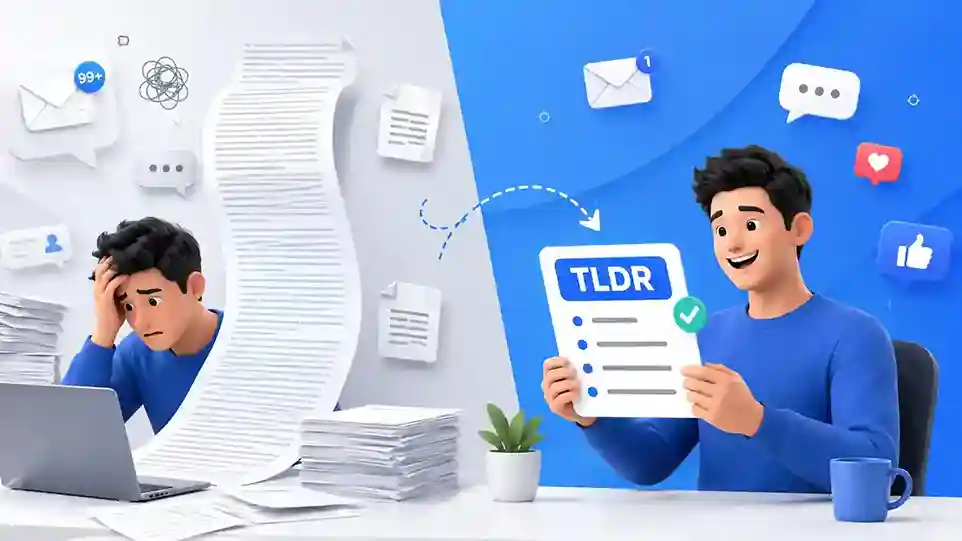
You open a long email, a dense article, or a wall of text in a group chat. Your eyes glaze over. You just want the point, not the paragraph. That frustration is exactly why the internet invented a fix. Below, you’ll get the full TLDR meaning, where it came from, and how to use it the right way in real life — at work, in texts, and online.
1. What Is the TLDR Meaning in Simple Words?
The TLDR meaning is straightforward: it stands for “Too Long; Didn’t Read.” People add it before or after a large chunk of text to flag one thing — the content is long, and here’s the short version instead.
You’ll usually see it in two spots:
- At the top, as a quick summary before the full explanation
- At the bottom, as a wrap-up after someone has already made their case
Both uses share the same goal: respect the reader’s time. That single idea is the heart of the TLDR meaning, no matter where you see the term.
2. Where Did TLDR Come From? A Quick History
The TLDR meaning didn’t start in a boardroom or a dictionary — it started on early internet forums. <cite index=”1-1″>The phrase emerged in the late 1990s and early 2000s on discussion platforms like Usenet groups, Slashdot, and early message boards, where long, detailed posts were common and patience for them was not.</cite>
The phrase started to be used by readers who did not wish to read through paragraphs as a clear indication that they had completely ignored the post. Over time, that criticism flipped into something useful. <cite index=”1-1″>To counteract that response, authors began including a brief synopsis at the beginning of lengthy postings, which is exactly how the contemporary TLDR originated.</cite>
The term picked up steam from there:
- Early 2000s – appears regularly on tech and internet forums
- Late 2000s – spreads through Reddit and early social platforms
- 2013: acknowledged as common slang by a major English dictionary
- 2018 – added to the Oxford English Dictionary, alongside words like “emoji”
Today, the TLDR meaning has moved far beyond forums. You’ll find it in newsletters, LinkedIn posts, product documentation, and even news outlets that use “TLDR” style summary boxes.
3. TLDR vs TL;DR — Is There a Difference?
Not really, but there’s a small nuance worth knowing. <cite index=”1-1″>The original form, “TL;DR,” includes a semicolon and reflects the term’s early internet roots on forums and blogs. Over time, “TLDR” without punctuation became more common as typing habits shifted toward speed.</cite>
| Version | Common Use | Feel |
| TL;DR | Blogs, formal write-ups, articles | Slightly more deliberate |
| TLDR | Texting, chat apps, social media | Casual, quick |
| tldr (lowercase) | Informal chats, code comments | Very casual |
| #TLDR | Social captions, hashtags | Attention-grabbing |
None of these change the actual TLDR meaning — they’re stylistic choices, not different definitions. Pick the version that matches the tone of where you’re writing.
4. How to Use TLDR in a Sentence
Using the term correctly is easy once you see it in context. Here are a few natural examples:
- “TLDR: the meeting got pushed to Thursday at 3 PM.”
- “That report was 12 pages — TLDR, revenue is up 18% this quarter.”
- “TLDR: I loved the product, but shipping took two weeks.”
Notice the pattern — one short sentence, the core fact, nothing extra. That’s the whole point behind the TLDR meaning: strip a long story down to what actually matters.
5. TLDR Meaning in Texting and Social Media
In casual messaging, the TLDR meaning shifts slightly toward tone. It’s often used to:
- Warn a friend a message is long before they open it
- Poke fun at your own rambling text
- Summarize a group chat argument nobody wants to scroll through
On platforms like X (formerly Twitter), Reddit, and Instagram captions, TLDR often appears with a colon, followed by one punchy line. It works because people’s attention spans on social apps are short, and a synopsis at the outset keeps users interested rather than scrolling through.
6. TLDR Meaning in Emails and Workplace Communication
Professional use is where the TLDR meaning becomes genuinely useful rather than just trendy. Busy managers, clients, and teammates often skim. A TLDR line at the top of a long email does real work:
- Saves the reader time
- Reduces back-and-forth “can you summarize this?” replies
- Makes your writing look organized and confident
A simple structure that works well in business emails:
- Subject line – clear and specific
- TLDR line – one to two sentences with the key takeaway
- Full details – background, data, and next steps below
One caution here: in very formal settings — legal documents, client-facing reports, executive summaries for senior leadership — swap “TLDR” for “Summary” or “Key Takeaways.” The TLDR meaning is still casual at its core, so match it to the room.
7. TLDR Meaning in Academic and Research Writing
Students and researchers borrow the same idea, even if they don’t always use the exact term. A TLDR-style line at the top of a paper, thesis chapter, or research note mirrors what an abstract does in academic writing — a compressed version of the full argument.
The difference is tone. An abstract is formal and structured. A TLDR is direct and conversational. Both exist for the same reason: readers want the conclusion before they commit to the details.
8. How to Write an Effective TLDR (Step-by-Step)
Writing an effective TLDR is a skill, not just a habit. Follow these steps:
- Finish writing first. You can’t summarize something you haven’t fully thought through.
- Identify the single most important point. Not three points — one.
- Reduce it to just one or two phrases. If it needs a third, keep trimming.
- Remove filler words. Skip phrases like “basically” or “just to say.”
- Read it in isolation from the remainder of the text. Does it still make sense? If yes, it’s ready.
A strong TLDR should never confuse someone who reads only that line. That’s the real test of the TLDR meaning in practice — clarity without context.
9. Common Mistakes People Make With TLDR
Even a simple concept gets misused. Watch out for these:
- Writing a TLDR that’s longer than three sentences — defeats the purpose entirely
- Using vague language like “stuff happened” instead of actual facts
- Adding a TLDR to short content that didn’t need one in the first place
- Using it dismissively on someone else’s work, which can come across as rude
- Skipping the full explanation entirely and relying on the TLDR as the whole message
Avoiding these keeps your writing sharp and keeps the TLDR meaning doing its actual job — saving time, not causing confusion.
10. TLDR vs Summary vs Abstract — What’s the Difference?
These three terms overlap, but they aren’t identical.
| Term | Length | Tone | Where It’s Used |
| TLDR | 1–2 sentences | Casual, direct | Forums, chats, emails, blogs |
| Summary | A short paragraph | Neutral, professional | Reports, articles, business docs |
| Abstract | 150–300 words | Formal, structured | Academic papers, research journals |
Knowing this difference helps you choose the right word for the right setting — and shows you understand the TLDR meaning goes beyond just “a short version of something.”
11. Similar Terms You Should Know
The TLDR meaning has inspired a small family of related internet shorthand. Recognizing these helps you read online content faster:
- “Too Long; Did not Watch,” or TLDW, is a term for long videos.
- Podcasts are referred to as “Too Long; Did not Listen,” or TLDL.
- ELI5 – “Explain Like I’m 5,” a request for a simpler explanation
- IMO / IMHO – “In My Opinion / In My Humble Opinion”
- NGL – “Not Gonna Lie”
These terms share the same DNA as TLDR: internet culture finding fast, compressed ways to communicate.
12. Real Examples of TLDR in Everyday Use
Seeing the term in action makes the TLDR meaning click faster:
Marketing report: “TLDR: Email signups grew 32% after the redesign. Full breakdown below.”
Product review: “TLDR: Great battery life, terrible camera, worth it for the price.”
News summary: “TLDR: New policy takes effect next month; here’s what changes for small firms.”
Group chat: “TLDR: supper moved to 7, bring your own beverages.”
Each example proves the same rule — the reader gets the outcome first, details second.
13. Should You Add a TLDR to Your Own Content?
A TLDR adds significant value if your material is longer than 300–400 words. It works especially well for:
- Blog posts and long-form articles
- Internal company memos
- Product update announcements
- Customer support explanations
- Newsletter roundups
Short social captions or two-line texts don’t need one — that’s where the mistake from Section 9 comes back in. Use judgment, not habit.
Comparison Table: TLDR Meaning Across Platforms
| Platform | Common Usage | Typical Length | Tone |
| Reddit / Forums | Post summaries | 1 sentence | Casual |
| Executive-style openers | 1–2 sentences | Semi-professional | |
| Blogs / Articles | Reader-friendly intros | 2–3 sentences | Informative |
| Text Messages | Quick heads-up | Few words | Very casual |
| LinkedIn Posts | Attention hook | 1 sentence | Professional-casual |
| Academic Notes | Informal abstract | 1–2 sentences | Direct |
FAQs
1. What does TLDR stand for?
TLDR stands for “Too Long; Didn’t Read.” It signals that a shortened version of a longer piece of content follows.
2. Is TLDR rude to use?
It can be, depending on context. It feels harsh when used as a disparaging remark about someone else’s work. Used as your own summary tool, it’s simply practical.
3. Is TLDR appropriate for business emails?
Yes, in most modern workplaces it’s accepted and even appreciated. For very formal or executive-facing documents, use “Summary” or “Key Takeaways” instead.
4. What’s the difference between TLDR and TL;DR?
No real difference in meaning — TL;DR is the original, punctuated version, and TLDR is the shortened, more casual form. Both are used interchangeably today.
5. How long should a TLDR be?
The ideal sentence length is one to two. Anything longer starts to defeat the purpose of a quick summary.
6. Where did TLDR originate?
It started on early internet forums and message boards in the late 1990s and early 2000s, before spreading to mainstream platforms like Reddit, Twitter, and beyond.
Conclusion
Knowing what the TLDR means is more than just online trivia; it is a tiny habit that helps you write more clearly and communicate with greater consideration. Whether you’re drafting an email, a blog post, or a group chat message, adding one short, honest summary line respects the other person’s time and gets your point across faster.