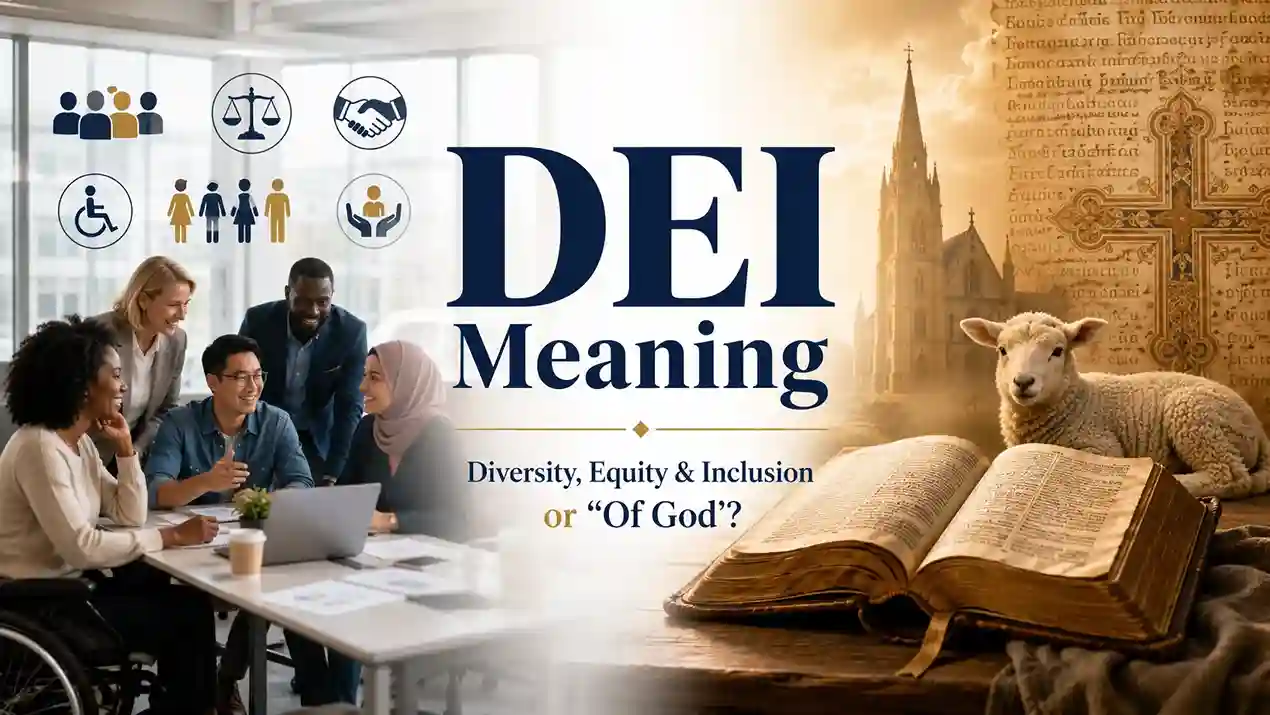
Search “DEI meaning” and you get four different answers on four different sites. One page talks about workplace diversity, another quotes the Bible, and a third mentions a Catholic organization. That mix-up wastes your time and leaves you unsure which definition fits your question.
This guide sorts out every meaning of DEI — from diversity, equity, and inclusion to Imago Dei, Agnus Dei, and Opus Dei — in plain language you can use right away.
What Does DEI Mean?
The letters D-E-I carry two completely separate meanings, and mixing them up is the most common mistake people make online.
- As an English acronym, DEI stands for Diversity, Equity, and Inclusion — a workplace and social framework.
- As a Latin word, “Dei” is the genitive form of “Deus,” meaning “of God.” You see it in phrases like Imago Dei, Agnus Dei, and Opus Dei.
The correct DEI meaning always depends on the context of the sentence. A company memo and a church hymn use the same three letters but point to entirely different ideas.
| Term | Language | Literal Meaning | Where You’ll See It |
| DEI | English acronym | Diversity, Equity, Inclusion | HR policies, business, government |
| Imago Dei | Latin | Image of God | Theology, Genesis 1:27 |
| Agnus Dei | Latin | Lamb of God | Catholic Mass, hymns |
| Opus Dei | Latin | Work of God | Catholic prelature founded in 1928 |
| Corpus Dei | Latin | Body of God | Feast of Corpus Christi |
DEI Meaning: Diversity, Equity, and Inclusion Explained
This acronym, which is used in business and HR circles, focuses on three related concepts that collaborate.
- Diversity — the presence of people with different backgrounds, races, genders, ages, abilities, and life experiences.
- Equity — fair access to opportunities, tools, and resources, adjusted for each person’s starting point.
- Inclusion — a culture where every person feels heard, valued, and able to contribute fully.
A helpful way to remember the DEI meaning is this: diversity is who is in the room, equity is how fairly they get to participate, and inclusion is whether they actually feel welcome once they’re there. Companies pair these three ideas to shape hiring, training, and everyday workplace decisions.
Most people who search “dei meaning diversity equity inclusion” want this exact breakdown rather than a one-line dictionary answer, so keep these three definitions side by side whenever you explain the term to a colleague.
DEI Meaning in Business: Why Companies Use It
Businesses adopted DEI to describe hiring practices, leadership training, and workplace culture programs aimed at fair treatment for every employee.
Grasping the DEI meaning in a corporate context matters because it shapes real decisions, not just talking points. Common business applications include:
- Structured interviews that reduce bias in hiring decisions
- Pay equity audits that evaluate pay for different positions
- Mentorship programs for underrepresented employees
- Leadership training on inclusive communication
Organizations like SHRM have refined how they talk about this framework in recent years. HR groups describe the underlying goal as helping organizations meet the needs of people from all walks of life. Some companies now use alternate labels such as IE&D or I&D, but the core idea behind these programs stays consistent: build a workforce where talent gets a fair shot regardless of background.
DEI Meaning in Government: Policies and Programs
Government agencies apply DEI through hiring rules, contractor requirements, and internal training programs. Federal, state, and local agencies each set their own scope for these efforts.
Recent federal action has reshaped this landscape significantly. On January 20, 2025, an executive order titled “Ending Radical and Wasteful Government DEI Programs and Preferencing” directed federal agencies to terminate DEI-related offices, programs, and positions within sixty days. The following day, there was another order. That order, “Ending Illegal Discrimination and Restoring Merit-Based Opportunity,” asserted that DEI programs are illegal and directed agencies to end related programs and activities.
These changes show how DEI policy in government can shift quickly based on the administration in office. Agencies that once ran dedicated diversity offices have scaled back or eliminated them entirely, while contractor rules tied to older executive orders have also been rescinded.
DEI Meaning in Politics: Why It Sparks Debate
The DEI meaning has become one of the most politically charged terms in American public life. Supporters and critics frame it in very different ways.
Supporters argue that:
- DEI programs bridge long-standing gaps in hiring and advancement.
- Diverse teams often produce stronger business results
- Equity measures address barriers that affect specific groups
Critics argue that:
- DEI programs can create new forms of unfair treatment
- Merit should be the sole factor in hiring and admissions
- Some programs lack clear measurement of actual outcomes
DEI programs faced increased scrutiny even before the 2025 policy changes, following Supreme Court decisions on college admissions programs. The DEI definition has significantly more weight in politics than a straightforward dictionary definition because of this ongoing legal and political dispute. Both sides use the same three letters to argue for opposite conclusions.
Imago Dei Meaning: The Biblical Root of Human Dignity
Imago Dei is a Latin theological term meaning “image of God.” It comes directly from Genesis 1:27, where scripture states that God created humanity in His own image.
This concept forms one of the oldest ideas connected to the word “Dei” in religious history:
- It teaches that every person carries inherent worth and dignity.
- Theologians use it to explain human capacity for reason, morality, and relationship.
- Christian ethics on human rights and the sanctity of life trace back to this idea.
Unlike the workplace DEI meaning, Imago Dei has nothing to do with corporate policy. It is a theological statement about human identity that predates the modern DEI acronym by thousands of years.
Agnus Dei Meaning: Lamb of God in Christian Worship
Agnus Dei translates to “Lamb of God” and refers to Jesus Christ in Christian theology. In John 1:29, John the Baptist refers to Jesus as “the Lamb of God who takes away the sin of the world.” This is where the title originates.
You’ll encounter Agnus Dei in these settings:
- A recited or sung prayer during the Catholic Mass, just before Communion
- Classical and sacred music compositions, including settings by Mozart and Fauré
- Christian artwork that uses a lamb as a representation of atonement and sacrifice
Agnus Dei shares its Latin root with DEI meaning discussions, but the two terms serve completely different purposes — one is a liturgical prayer, the other is a modern policy acronym.
Opus Dei Meaning: The Catholic Organization Explained
“Work of God” is what Opus Dei means in Latin. It is a Roman Catholic organization whose members seek personal Christian perfection and strive to apply Christian values in their daily work and in society.
Key facts about Opus Dei:
- Father Josemín Escriň founded it in 1928 while on a pilgrimage in Madrid.
- Pope Pius XII granted the organization final and complete approval in 1950.
- Pope John Paul II elevated it to the status of a personal prelature in 1982.
- Its full official name is the Prelature of the Holy Cross and Opus Dei.
- Members include both laypeople and ordained priests across dozens of countries.
Opus Dei has also attracted public scrutiny over the years. Critics have accused the organization of secrecy and cultlike practices, along with political ambitions in countries such as Spain and the United States, though it denies these claims. Despite sharing the term “Dei,” this Opus Dei meaning—a structured Catholic organization centered on sanctifying routine labor—has nothing to do with workplace diversity initiatives.
DEI Meaning in the Bible: How the Term Connects to Scripture
The Bible does not use “DEI” as an English acronym, so a “dei meaning in bible” search actually points people toward Latin phrases translated from scripture. Three phrases matter most:
- Imago Dei (Genesis 1:27) — humans made in God’s image
- Agnus Dei (John 1:29) — Jesus described as the Lamb of God
- Verbum Dei — “Word of God,” a phrase describing scripture itself
Readers searching for a biblical connection usually want one of these three concepts rather than a modern HR term. Recognizing this distinction saves confusion and points you to the right passage.
DEI vs Dei: Comparison Table of Every Meaning
This table lays out every major definition side by side so you can find your answer in seconds.
| Context | Full Meaning | Origin | Typical Use Case |
| Business | Diversity, Equity, Inclusion | Modern HR terminology | Hiring, training, culture programs |
| Government | Diversity, Equity, Inclusion | Federal and state policy | Agency programs, contractor rules |
| Politics | Diversity, Equity, Inclusion | Public policy debate | Legislation, executive orders, court rulings |
| Imago Dei | Image of God | Latin, Genesis 1:27 | Theology, human dignity |
| Agnus Dei | Lamb of God | Latin, John 1:29 | Catholic Mass, sacred music |
| Opus Dei | Work of God | Latin, founded 1928 | Catholic personal prelature |
| Corpus Dei | Body of God | Latin | Feast of Corpus Christi |
How Organizations Implement DEI: A Practical Framework
Once a company settles on the workplace DEI meaning it wants to pursue, implementation follows a fairly consistent pattern.
- Assess current data. Review hiring, promotion, and pay data by demographic group.
- Set measurable goals. Define specific, trackable targets rather than vague commitments.
- Train leadership first. Managers set the tone for how inclusion shows up day to day.
- Build feedback loops. Regular employee surveys catch problems early.
- Report progress publicly. Transparency fosters confidence among employees and stakeholders.
Companies that skip the data step often struggle to show results, which fuels criticism that DEI programs lack accountability. A clear framework keeps these efforts grounded in outcomes rather than slogans.
Common Misconceptions About DEI
Several myths follow the DEI meaning wherever it appears online. Clearing them up helps readers form their own informed view.
- Myth: DEI means hiring by quota. Instead than establishing strict numerical quotas, the majority of initiatives concentrate on eliminating bias from current procedures.
- Myth: DEI and equality mean the same thing. Equality gives everyone identical resources; equity adjusts resources based on need.
- Myth: DEI is only a corporate trend. Government agencies, universities, and nonprofits have used similar frameworks for decades under different names.
- Myth: All Latin “Dei” terms relate to acronym DEI. Imago Dei, Agnus Dei, and Opus Dei predate the modern acronym by centuries and share no connection beyond spelling.
FAQs
What does DEI mean in simple terms?
DEI stands for Diversity, Equity, and Inclusion — a framework companies and governments use to build fair, welcoming environments for people of different backgrounds.
What is the Imago Dei meaning?
The Latin phrase “image of God” is Imago Dei. It comes from Genesis 1:27 and teaches that every human being reflects God’s image and carries inherent dignity.
What is the Opus Dei meaning?
Opus Dei means “Work of God.” It refers to a Catholic personal prelature founded in Madrid in 1928, focused on helping members find holiness through everyday work.
What is the Agnus Dei meaning?
Agnus Dei means “Lamb of God.” It is a title for Jesus Christ used in Catholic Mass and classical sacred music, drawn from John 1:29.
Why is DEI controversial in politics?
Supporters say DEI corrects historic hiring and access gaps, while critics argue it can conflict with merit-based selection. Recent U.S. executive orders have added legal and political weight to this debate.
Is the DEI meaning the same in every country?
No. The core idea of fairness stays similar, but specific laws, terminology (such as EDI or IE&D), and enforcement vary widely between the United States, Canada, the UK, and other countries.
Conclusion
Understanding the correct DEI meaning starts with context. You can now confidently distinguish between a hiring policy, a Bible scripture, and a Catholic organization that all utilize the same three letters for completely different purposes.