Millions of drivers see the word “Opel” every day, yet most never learn where it came from. That gap leaves a simple question unanswered: what does this German name actually stand for? This guide closes that gap. You will walk away knowing the exact opel meaning, the founder behind it, and why a lightning bolt sits on every badge.
What Does Opel Mean? A Quick Answer
The opel meaning is simpler than most people expect. Opel is not an acronym, a German word, or a hidden code. It is a family surname, taken directly from the company’s founder, Adam Opel.
He built the business in 1862, and his descendants carried his name onto every vehicle the factory produced. So when someone asks about opel meaning, the honest answer starts with one man, not one word.
- Short answer: Opel means “Adam Opel,” the German founder whose surname became the brand.
- Long answer: Explained fully in the sections below.
The Real Origin of the Opel Name
Understanding opel meaning requires a trip back to 19th-century Germany. Adam Opel was born in 1837 in Rüsselsheim, a small town near Frankfurt. He trained as a locksmith and machinist before starting his own workshop.
German surnames like Opel often trace back to regional or occupational roots from Middle High German. Over time, the family name stopped being just a surname. It became a label people trusted on machines, then bicycles, then cars.
That trust is the real weight behind opel meaning today. It is not a clever wordplay. It is a legacy built one product at a time.
Who Was Adam Opel? The Man Behind the Brand
Adam Opel founded his company in 1862, and his personal drive shaped everything that followed. He was not born wealthy. He earned his skills through years of hands-on training as a craftsman.
That practical, hands-on approach became part of the company culture. Adam Opel passed away in 1895, four years before his sons produced the brand’s first automobile. His five sons then took the company in a direction he never lived to see: cars.
Grasping this backstory adds real depth to opel meaning. The name honors a craftsman, not a corporation with no face behind it.
From Sewing Machines to Bicycles: Opel’s Surprising Start
Here is a fact that surprises most people researching opel meaning: the company did not start with engines at all. Adam Opel began by manufacturing sewing machines in 1862.
By 1886, the business expanded into bicycles. Opel quickly grew into the largest bicycle manufacturer in Germany, a position it held into the early 1900s.
- 1862 — Sewing machine production begins in Rüsselsheim.
- 1886 — Opel starts building bicycles.
- Early 1900s — Opel becomes Germany’s largest bicycle maker.
This progression matters because it shows the brand’s identity was built on manufacturing skill first, not on cars. That skill later transferred directly into automobile production.
How Opel Entered the Automobile Industry
Adam Opel’s five sons converted the family factory into an automobile operation in 1898, three years after their father’s death. Their first product, the Opel-Lutzmann, launched in 1899 but did not last long on the market.
The brothers introduced their first original design, a twin-cylinder model, in 1902. From there, Opel expanded quickly, adding trucks to its lineup by 1913.
A factory fire destroyed the plant in 1911. Rather than slow the company down, the rebuild let Opel install more modern, efficient equipment. Opel later became the first German manufacturer to adopt assembly-line production, a milestone that pushed output far ahead of most competitors.
What Does the Opel Logo Mean?
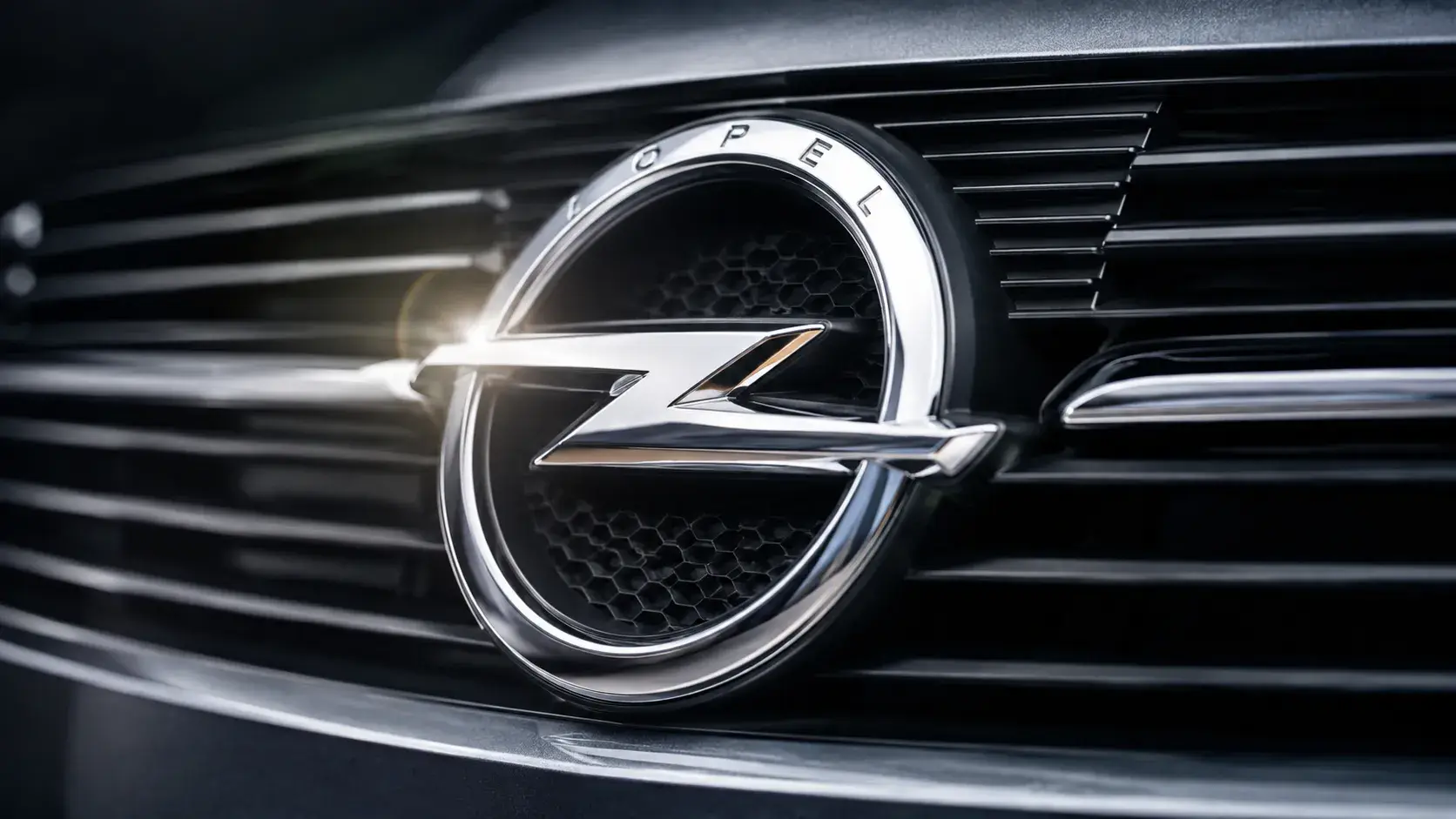
Anyone digging into opel meaning eventually asks about the badge itself. The modern Opel logo shows a horizontal lightning bolt inside a circle, and that design has a clear backstory.
The symbol traces back to a 1930 Opel truck emblem, chosen to represent origin, power, and performance. The circle-and-bolt combination we recognize today first appeared in the early 1960s and has been refined many times since.
- The bolt communicates speed and energy.
- The circle represents unity and precision engineering.
- The 2024 redesign leans further into electric mobility, linking the bolt visually to electric power.
The Opel Blitz: Meaning Behind the Lightning Bolt
The German word for the bolt is “Blitz,” which translates directly to lightning. The shape is horizontal rather than vertical for a specific reason: it echoes the twin stripes painted on Opel’s earliest trucks.
Opel used the Blitz name on trucks for decades, and the emblem eventually became shorthand for the entire brand’s engineering identity. Understanding this detail rounds out opel meaning beyond just the surname story.
The logo evolved through roughly ten redesigns since the company began, moving from ornate Victorian lettering to the sleek, minimal bolt used today.
Opel Ownership Timeline: From GM to Stellantis
Opel meaning also involves ownership, since the company has changed hands more than once while keeping its founder’s name intact. Here is the short version:
- 1929–2017 — Owned by General Motors, an American automaker.
- 2017 — Acquired by PSA Peugeot Citroën (PSA Group) for roughly €2 billion.
- 2021 to present — Part of Stellantis, formed when PSA merged with Fiat Chrysler Automobiles.
Through every ownership change, the Opel name and Rüsselsheim headquarters stayed constant. That consistency is a major reason opel meaning still points back to Adam Opel, even under new corporate parents.
Opel vs Vauxhall: Same Cars, Different Name
British buyers rarely see the Opel badge, and there is a simple reason why. Since the 1980s, most Opel vehicles sell in the United Kingdom under the Vauxhall name instead.
The cars share engineering, platforms, and design almost entirely. Only the badge and a handful of trim details change between markets. If you own a Vauxhall, you already own an Opel in every practical sense.
Why Opel Still Matters in the Automotive World Today
Opel remains headquartered in Rüsselsheim am Main, the same town where Adam Opel started his workshop. The company builds passenger cars, light commercial vehicles, and parts distributed across more than 60 countries.
Opel also has a lesser-known chapter in aerospace history. In 1928, the Opel-RAK program launched some of the earliest rocket-propelled vehicles, an early step toward modern rocket propulsion research.
That range, from sewing needles to rocket sleds to electric cars, shows why opel meaning carries more weight than a simple dictionary definition. It reflects over 160 years of continuous German engineering.
Opel Meaning Table: Quick Facts at a Glance
| Fact | Detail |
| Name origin | German surname of founder Adam Opel |
| Founded | 1862, in Rüsselsheim am Main, Germany |
| First product | Sewing machines |
| Second product line | Bicycles, starting 1886 |
| First car | Opel-Lutzmann, 1899 |
| Logo symbol | Lightning bolt (“Blitz”) in a circle |
| Logo origin | Based on a 1930 Opel truck emblem |
| Sister brand | Vauxhall (United Kingdom) |
| Past owner | General Motors, 1929–2017 |
| Past owner | PSA Group, 2017–2021 |
| Current owner | Stellantis, since 2021 |
| Current markets | 60+ countries worldwide |
Common Myths About the Opel Name (Debunked)
A few myths follow opel meaning around the internet, and they deserve a direct correction.
- Myth: Opel is an acronym. It is not. It is a family surname, nothing more.
- Myth: Opel started as a car company. It began with sewing machines, then bicycles, decades before its first automobile.
- Myth: The lightning bolt has always looked the same. The badge has gone through roughly ten redesigns since the 1900s.
Clearing up these myths gives readers a more accurate, trustworthy picture of the brand.
FAQs
What does Opel mean in English?
Opel does not translate into an English word. It is the surname of founder Adam Opel, so the opel meaning is simply “named after Adam Opel,” a German industrialist born in 1837.
Is Opel a German or American brand?
Opel is a German brand, founded and still headquartered in Rüsselsheim am Main, Germany. It has had American ownership in the past under General Motors, but the company and its name remain German.
Who founded Opel and when?
Adam Opel founded the company in 1862 as a sewing machine manufacturer. His five sons later converted the business into an automobile maker in 1898, after his death in 1895.
What does the Opel logo lightning bolt represent?
The lightning bolt, called the “Blitz,” represents speed, power, and engineering precision. It originates from a 1930 Opel truck emblem and became the brand’s official symbol in the early 1960s.
Who owns Opel now?
Stellantis owns Opel today. The brand moved from General Motors to the PSA Group in 2017, then became part of Stellantis in 2021 when PSA merged with Fiat Chrysler Automobiles.
Is Vauxhall the same as Opel?
Yes, in practical terms. Vauxhall is the name used for Opel vehicles sold in the United Kingdom, and the cars share nearly identical engineering and design under both badges.
Final Thoughts on Opel Meaning
Opel meaning comes down to one clear fact: a German craftsman named Adam Opel built something that outlived him by over 160 years. From sewing machines to bicycles to cars to rockets, that name has stretched across more industries than almost any other automaker’s.
Next time you see the lightning bolt on a car badge, you will know exactly whose name and vision it carries. Share this guide with anyone who has ever wondered the same thing, and explore our other brand-history breakdowns to keep building your automotive knowledge.