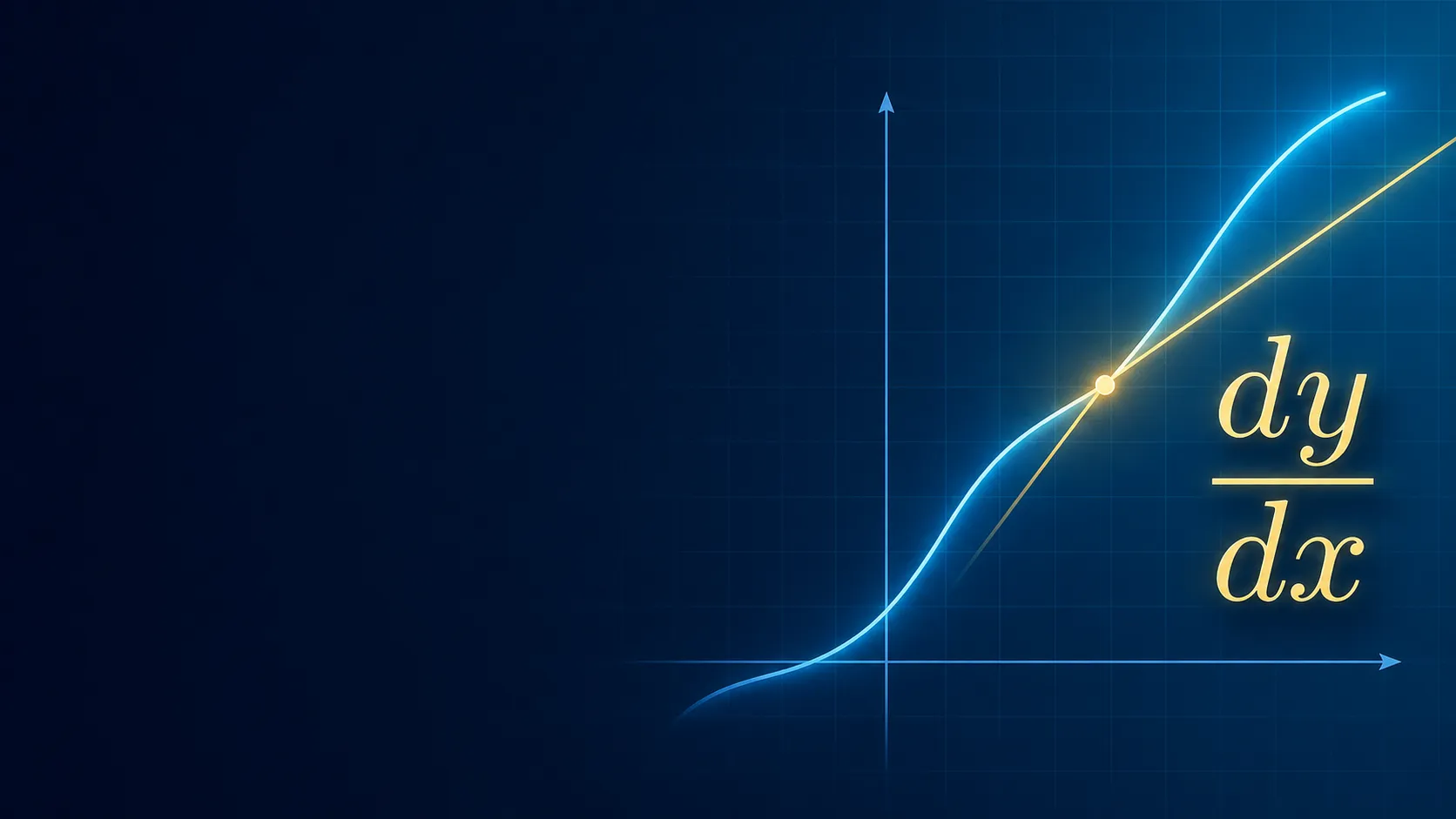
Staring at “dy/dx” on a homework page and feeling lost is normal. Most students hit this symbol before anyone explains it clearly, so the panic sets in fast. Here’s the good news: once you see what dy/dx actually stands for, it becomes one of the simplest ideas in calculus. This guide breaks it down step by step, with real examples and zero confusing jargon.
What Does dy/dx Mean? (Quick Answer)
In simple terms, dy/dx means “the derivative of y with respect to x.” It measures how fast the value of y changes as x changes by a tiny amount. Picture a car’s speedometer: it shows how fast distance changes as time passes. dy/dx does the same job for any two related quantities, y and x.
So when someone asks what does dy/dx mean, the short answer is: it’s the instantaneous rate of change of one variable compared to another. It is not a regular fraction, even though it looks like one. It’s a single symbol built from two parts, dy and dx, that together describe a slope at one exact point on a curve.
| Symbol | Read As | Meaning |
| dy/dx | “dee-why, dee-ex” | Derivative of y with respect to x |
| dy | “dee-why” | A tiny change in y |
| dx | “dee-ex” | A tiny change in x |
| d²y/dx² | “dee-two-why, dee-ex-squared” | Second derivative (rate of change of the rate of change) |
The History and Origin of dy/dx Notation
The dy/dx symbol was introduced by Gottfried Wilhelm Leibniz in the late 1600s, around the same time Isaac Newton was developing calculus independently in England. Newton used dot notation (like ẏ), while Leibniz used the dy/dx format we still teach today. Leibniz designed his notation to look like a ratio on purpose, because it reminds students that a derivative comes from dividing a small change in y by a small change in x.
This origin story matters because it explains why dy/dx behaves like a fraction in some situations, such as the chain rule, but is technically a limit, not a division problem. Knowing this history removes a lot of the mystery behind the symbol.
How to Read dy/dx Out Loud
Many students avoid asking this question, so here it is answered plainly. dy/dx is read as “dee-why over dee-ex” or, more formally, “the derivative of y with respect to x.” You will rarely say “d-y divided by d-x” in a math class, because that phrasing wrongly suggests plain division.
- dy/dx → “the derivation of y with respect to x”
- dy/dt → that “the derivative of y with respect to t”
- “The derivative of f with respect to x” is defined as df/dx.
Once this phrase becomes automatic, reading calculus problems out loud gets much easier.
dy/dx vs dx/dy: What’s the Difference?
This is one of the most searched follow-up questions after “what does dy/dx mean,” and the answer is straightforward. dy/dx measures how y changes when x changes. dx/dy measures the opposite: how x changes when y changes. They are reciprocals of each other whenever both derivatives exist and are not zero.
| Expression | What It Measures | Formula Relationship |
| dy/dx | Change in y per unit change in x | dy/dx = 1 ÷ (dx/dy) |
| dx/dy | Change in x per unit change in y | dx/dy = 1 ÷ (dy/dx) |
A simple way to remember this: dy/dx always puts the variable you’re solving for on top.
The Derivative Definition Behind dy/dx
Formally, dy/dx is defined using a limit. If y is a function of x, written y = f(x), then:
dy/dx = limit as h approaches 0 of [f(x + h) − f(x)] / h
This formula captures the idea of “zooming in” on a curve until it looks like a straight line. That straight line’s slope is the derivative. So dy/dx is not an average rate of change over a big interval; it’s the exact rate of change at one single point.
Understanding this definition answers what does dy/dx mean at a deeper level: it’s the slope of the tangent line to a curve at any given point x.
Leibniz Notation vs Other Derivative Notations
Calculus offers several ways to write a derivative, and students often mix them up. Here’s a full comparison table so you can match notations instantly.
| Notation Style | Example | Created By | Best Used For |
| Leibniz notation | dy/dx | Gottfried Leibniz | Showing which variables are involved; common in physics and related rates |
| Lagrange notation | f'(x) | Joseph-Louis Lagrange | Quick, compact writing; common in algebra-based calculus |
| Newton’s notation | ẏ | Isaac Newton | Physics, especially motion with respect to time |
| Euler’s notation | Df(x) | Leonhard Euler | Operator-based calculus and advanced math |
All four notations describe the same mathematical operation, a derivative. The choice usually depends on the textbook, the course, or the field of study.
Step-by-Step: How to Calculate dy/dx
Finding dy/dx follows a repeatable process. Here is the basic method for a simple polynomial function.
- Write the function clearly, for example y = x³ + 4x.
- Apply the power rule to each term: bring the exponent down and subtract one from it.
- For x³, the derivative is 3x².
- For 4x, the derivative is 4.
- Add the results together: dy/dx = 3x² + 4.
This short process works for most polynomial functions. More advanced functions need extra rules, listed below.
- Power Rule: d/dx(xⁿ) = nxⁿ⁻¹
- Product Rule: d/dx(uv) = u’v + uv’
- Quotient Rule: d/dx(u/v) = (u’v − uv’) / v2
- Chain Rule: dy/dx = dy/du × du/dx
Practicing these rules with small examples builds real confidence in reading and solving dy/dx problems.
Real-World Examples of dy/dx in Action
Derivatives are not just classroom exercises. They show up constantly in daily life and professional work.
- Speed and distance: If y is distance and x is time, dy/dx gives speed.
- Population growth: If y is population size and x is time, dy/dx shows the growth rate.
- Business profit: If y is total profit and x is number of units sold, dy/dx reveals profit per additional unit.
- Temperature change: If y is temperature and x is time, dy/dx tells you how fast a room is heating or cooling.
These examples make it easier to remember what dy/dx means, because it always answers the same question: how fast is one thing changing compared to another?
Common Mistakes Students Make with dy/dx
Even strong students trip over a few recurring errors. Avoiding these will save time and points on exams.
- Treating dy/dx as a simple fraction and canceling the “d” like a variable.
- Forgetting the chain rule when the inside of a function also depends on x.
- Mixing up dy/dx with dx/dy, which reverses the entire relationship.
- Skipping the definition of the derivative and memorizing rules without understanding why they work.
- Confusing average rate of change (a slope between two points) with dy/dx (a slope at one exact point).
Being aware of these mistakes early makes the rest of calculus far less stressful.
dy/dx in Physics, Engineering, and Economics
Outside pure math class, dy/dx shows up under different names but the same core idea. In physics, velocity is dx/dt and acceleration is dv/dt, both derivatives in disguise. In engineering, dy/dx describes stress, strain, and signal change over time. In economics, marginal cost and marginal revenue are both derivatives that answer “how much does this change if I produce one more unit?”
Seeing dy/dx used across these fields proves it is not an abstract symbol invented to confuse students. It is a practical tool used daily by engineers, economists, scientists, and analysts.
Higher-Order Derivatives: d²y/dx² Explained
Once dy/dx is clear, the next natural question is what comes after it. Taking the derivative of dy/dx produces d²y/dx², called the second derivative. It measures how the rate of change itself is changing.
- First derivative (dy/dx): velocity, or how position changes over time.
- Second derivative (d²y/dx²): acceleration, or how velocity changes over time.
- Third derivative (d³y/dx³): jerk, or how acceleration changes over time.
This chain of derivatives shows how one core idea, dy/dx, builds into deeper layers of analysis.
Tips to Master dy/dx Quickly
- Say the phrase “derivative of y with respect to x” every time you see the symbol, instead of reading it silently as a fraction.
- Practice the power rule daily until it becomes automatic.
- Draw a curve and a tangent line by hand to connect the formula to a real picture.
- Work through five real-world word problems each week to build intuition, not just formula memory.
- Review one mistake category from this guide before every quiz or test.
Small, consistent practice sessions beat long cramming sessions for building lasting understanding of dy/dx.
Conclusion: Turn Confusion Into Confidence
dy/dx is simply the derivative of y with respect to x, the exact rate at which y changes compared to x at any given point. Once the notation, the definition, and a few practice problems click into place, this symbol stops looking intimidating and starts looking like a genuinely useful tool.
Revisit the tables and steps above whenever a new problem feels unclear, and try solving three practice questions today to lock in what you just learned. Bookmark this guide so you always have a clear answer the next time dy/dx shows up on your screen.
FAQs
1. What does dy/dx literally mean?
dy/dx literally means the derivative of y with respect to x. It shows how much y changes for a very small change in x, measured at one specific point on a curve rather than across an entire interval.
2. Is dy/dx a fraction?
No, dy/dx is not a true fraction, even though it looks like one. It represents a limit of a ratio as the change in x approaches zero. In some rules, like the chain rule, it can be manipulated similarly to a fraction, but its core definition comes from a limit process.
3. What is the difference between dy/dx and f'(x)?
dy/dx and f'(x) represent the exact same concept, the derivative of a function, just written in two different notation styles. dy/dx is Leibniz notation and shows the variables directly, while f'(x) is Lagrange notation and is often faster to write.
4. Why do we use dy/dx instead of just saying “derivative”?
dy/dx tells you exactly which two variables are related, which becomes essential in problems with several variables, such as related rates or multivariable calculus. Simply saying “derivative” does not specify which variable is changing with respect to which other variable.
5. Can dy/dx be zero?
Yes, dy/dx equals zero at any point where the curve has a horizontal tangent line, such as the top of a hill or the bottom of a valley on a graph. These points are called critical points and are used to find maximum and minimum values of a function.
6. What does d²y/dx² mean?
d²y/dx² is the second derivative, meaning the derivative of dy/dx itself. It measures how the rate of change is changing, such as acceleration in physics, where the first derivative gives velocity and the second gives acceleration.