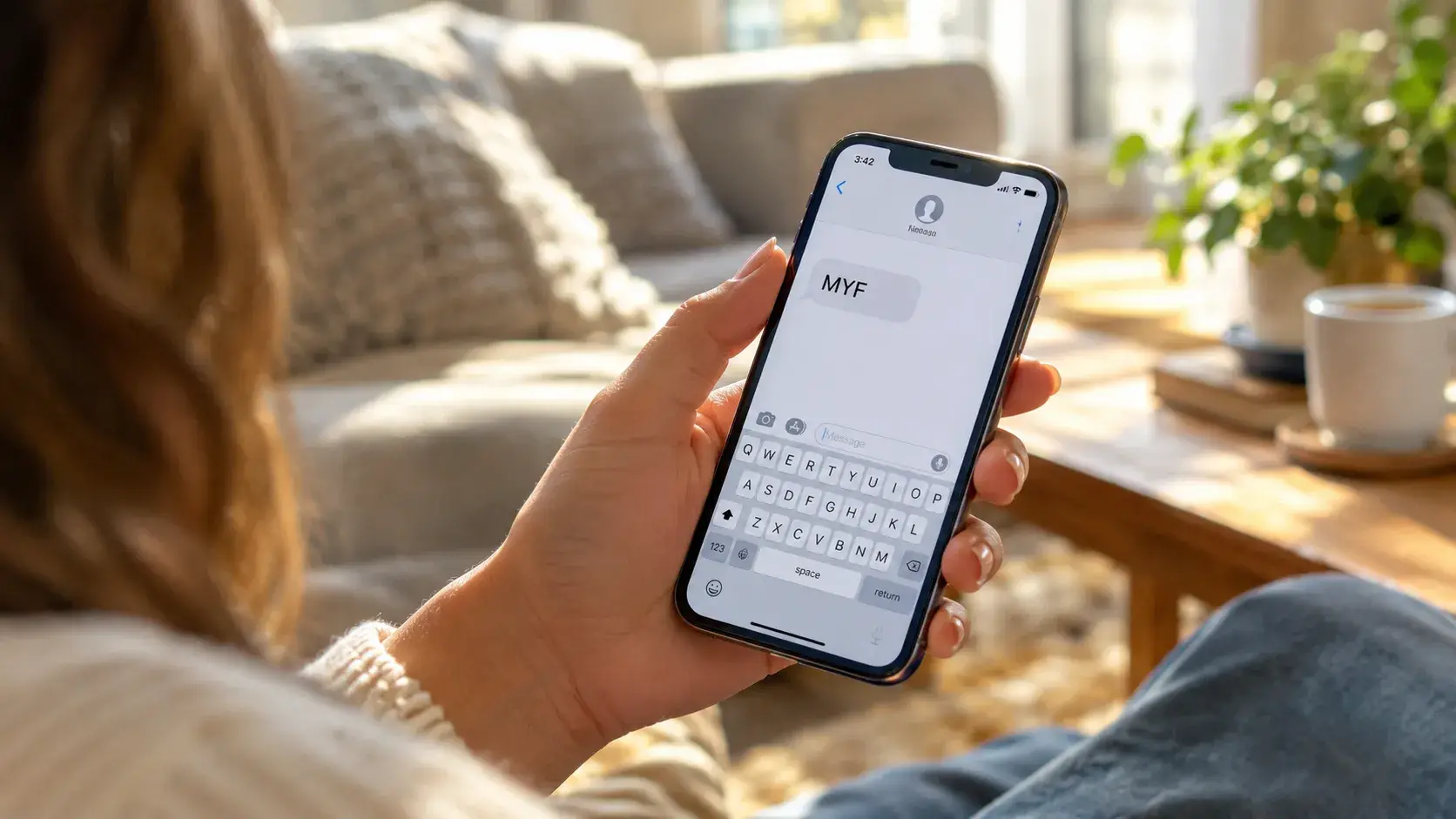
A text pops up. It just says “MYF.” No context, no emoji, nothing else. You stare at the screen and wonder if it’s a typo, a joke, or a word you’re supposed to already know. That confusion is exactly why so many people search for the myf meaning every single day. This guide clears it up in plain words, with real examples, so you never have to guess again.
What Does MYF Mean? (Quick Answer)
MYF most commonly stands for “My Fault.” People use it to quickly admit a small mistake without writing a full sentence. That is the short version of the myf meaning, but it is not the only one.
Depending on the app, the group chat, or the person typing it, MYF can also stand for:
- Miss Your Face – an affectionate way to say “I miss you”
- Mind Your Feelings – a light reminder to stay considerate
- Mind Your Fing Business – a blunt way to say “stay out of it”
- My Friends – used when referring to a group
Context decides which one applies. A sentence before or after “MYF” almost always tells you which meaning fits.
Where Did MYF Come From? A Short History of the Term
Texting slang grows out of one simple habit: typing less to say more. As phone keyboards got smaller and group chats got faster, short forms like LOL, BRB, and IDK became normal. MYF followed the same pattern.
The term started appearing in casual chats and comment sections where speed mattered more than spelling. Younger users on messaging apps picked it up first, and it slowly spread to comment threads on video platforms. Nobody owns the term, and no single app invented it, which is part of why the myf meaning shifts depending on where you see it.
The Real MYF Meaning: 5 Common Definitions Explained
Understanding the myf meaning gets easier once you separate it into its five common uses. Each one carries a different tone, so mixing them up can send the wrong message.
1. My Fault This is the apology version. Someone uses it after making a small error, forgetting a reply, or giving wrong information.
2. Miss Your Face This is the warm, friendly version. Friends or partners use it after not seeing each other for a while.
3. Mind Your Feelings This version works as a gentle nudge. It tells someone to be more careful with how they say something.
4. Mind Your Fing Business This is the sharper version. It tells someone to stop asking questions that are not their concern.
5. My Friends This version simply groups people together, often in captions like “MYF and I went out today.”
MYF Meaning Comparison Table
Here is a clear side-by-side breakdown so you can match the right meaning to the right situation.
| Meaning | Tone | Common Platform | Example Message | Best Reply |
| My Fault | Apologetic | Snapchat, group chats | “Forgot to text back, MYF” | “All good!” |
| Miss Your Face | Affectionate | Instagram DMs, texts | “Haven’t seen you in weeks, MYF” | “MYF too!” |
| Mind Your Feelings | Caring | Group chats | “MYF, don’t take it personally” | “Thanks for saying that” |
| Mind Your Fing Business | Blunt | Comment sections | “MYF, that’s private” | Best left without a reply |
| My Friends | Neutral | Captions, comments | “MYF and I at the game tonight” | A like or comment |
This table shows why one abbreviation can carry five different feelings. Reading the sentence around MYF, not just the letters themselves, is the fastest way to get the myf meaning right.
How to Use MYF in a Sentence (Real Examples)
Seeing MYF used correctly makes the myf meaning much easier to remember. Here are natural examples for each version:
- “I totally forgot to send that, MYF.”
- “It’s been way too long, MYF.”
- “MYF, I know that topic is sensitive for you.”
- “MYF, that’s between me and him.”
- “MYF are coming over this weekend.”
Notice how short these sentences are. MYF works best in casual, fast typing, not formal writing.
Does the MYF Meaning Change on TikTok, Snapchat, and Instagram?
The core meanings stay the same across apps, but the frequency changes. TikTok comment sections lean toward the “My Fault” version, especially under videos where a creator corrects earlier information. Snapchat conversations use MYF more for the “Miss Your Face” version because the app is built around close friends and quick personal messages.
Instagram DMs and captions show more mixed use. A caption might use “MYF” to mean “My Friends,” while a direct message from the same person could mean “Miss Your Face.” Always check the surrounding words before assuming.
MYF vs Similar Texting Slang
Comparing MYF with close abbreviations helps avoid mix-ups.
- MYF vs MYB: MYB usually means “My Bad,” which overlaps closely with the “My Fault” version of MYF. In informal conversations, they are frequently used interchangeably.
- MYF vs IMY: IMY means “I Miss You” directly, while “Miss Your Face” (a version of MYF) adds a playful twist to the same feeling.
- MYF vs NOTA: NOTA means “Not Of This Age,” used to call out immature behavior, while MYF rarely carries that judgmental tone.
Knowing these differences keeps your texts accurate and prevents awkward misunderstandings.
How to Reply When Someone Sends You MYF
Replying well depends entirely on which version was intended. A short pause to read the full message solves most confusion.
- If it feels like an apology, a simple “no worries” works fine.
- If it feels affectionate, mirroring it back (“MYF too”) keeps the warmth going.
- If it feels like a boundary being set, the safest reply is often no reply at all, or a short “understood.”
Matching the tone of the sender shows that you actually understood the myf meaning in that specific conversation, not just the general definition.
Common Mistakes People Make With MYF
Even fluent texters slip up with MYF sometimes. Watch out for these:
- Using it in formal writing. MYF has no place in emails, reports, or professional messages.
- Assuming one fixed meaning. Treating MYF as always meaning “My Fault” leads to confusing replies when someone meant something warmer or blunter.
- Sending it to people unfamiliar with texting slang. Older relatives or new coworkers may not recognize the abbreviation at all.
- Ignoring tone from earlier messages. MYF rarely stands alone; the sentence before it usually carries the real clue.
Avoiding these mistakes keeps conversations smooth and prevents unnecessary confusion.
When You Should Not Use MYF
Some situations call for full sentences instead of shorthand. Skip MYF when:
- Writing a work email or a message to a client
- Speaking with someone who might not be familiar with online terminology
- Apologizing for something serious, where a full sentence shows real accountability
- Writing anything that might be read by someone outside the original conversation
Slang like MYF is built for speed between people who already share context. Outside of that, it can easily be misread.
Is MYF Appropriate for Professional or Family Chats?
Family chats sit somewhere in the middle. A parent who already understands texting slang might read MYF as friendly shorthand. A grandparent unfamiliar with digital abbreviations may need the full phrase spelled out.
Professional chats are simpler to judge. MYF, in any of its versions, does not belong in workplace communication. A short, clear sentence always reads better in that setting and avoids any chance of misinterpretation.
Why Understanding MYF Meaning Actually Matters
Texting slang moves fast, and terms like MYF exist because language keeps adapting to shorter attention spans and quicker typing habits. It takes more than just decoding one acronym to understand the meaning of myf. It builds a small skill: reading context clues in digital conversations, which helps with dozens of other slang terms too.
Once the pattern clicks, similar acronyms become far easier to figure out on your own, without needing to search every single one.
FAQs
1. What does MYF mean in a text message?
MYF most often means “My Fault,” used as a quick, casual apology. The exact meaning can shift based on the conversation, so checking nearby messages helps confirm it.
2. Does MYF always mean “my fault”?
No. While “My Fault” is the most common version, MYF can also mean “Miss Your Face,” “Mind Your Feelings,” or “Mind Your Fing Business,” depending on tone and context.
3. Is MYF only used by teenagers?
Mostly, yes. Teens and young adults use MYF the most, since it fits fast-paced messaging apps like Snapchat and TikTok. Older users tend to write full phrases instead.
4. What is the opposite of MYF?
There is no single opposite, since MYF has multiple meanings. If MYF means “My Fault,” a rough opposite would be “Not my fault” or “NMF,” though that phrase is far less common.
5. Can MYF mean something negative?
It can, mainly in its “Mind Your Fing Business” form. That version carries a blunt, boundary-setting tone rather than a friendly one, so reading the full message matters.
6. How do I know which MYF meaning someone intends?
Look at the message right before and after it. Apologetic context points to “My Fault,” affectionate context points to “Miss Your Face,” and a sharp or defensive tone usually points to the “Mind Your Fing Business” version.
Final Thoughts
MYF is a small abbreviation with a surprisingly wide range of meanings, and now you know all of them. The next time it shows up in a text, a comment, or a caption, you will know exactly how to read it and how to reply without any guesswork.
Bookmark this guide, share it with a friend who just got confused by the same text, and drop a comment below if you have spotted a MYF meaning we missed.