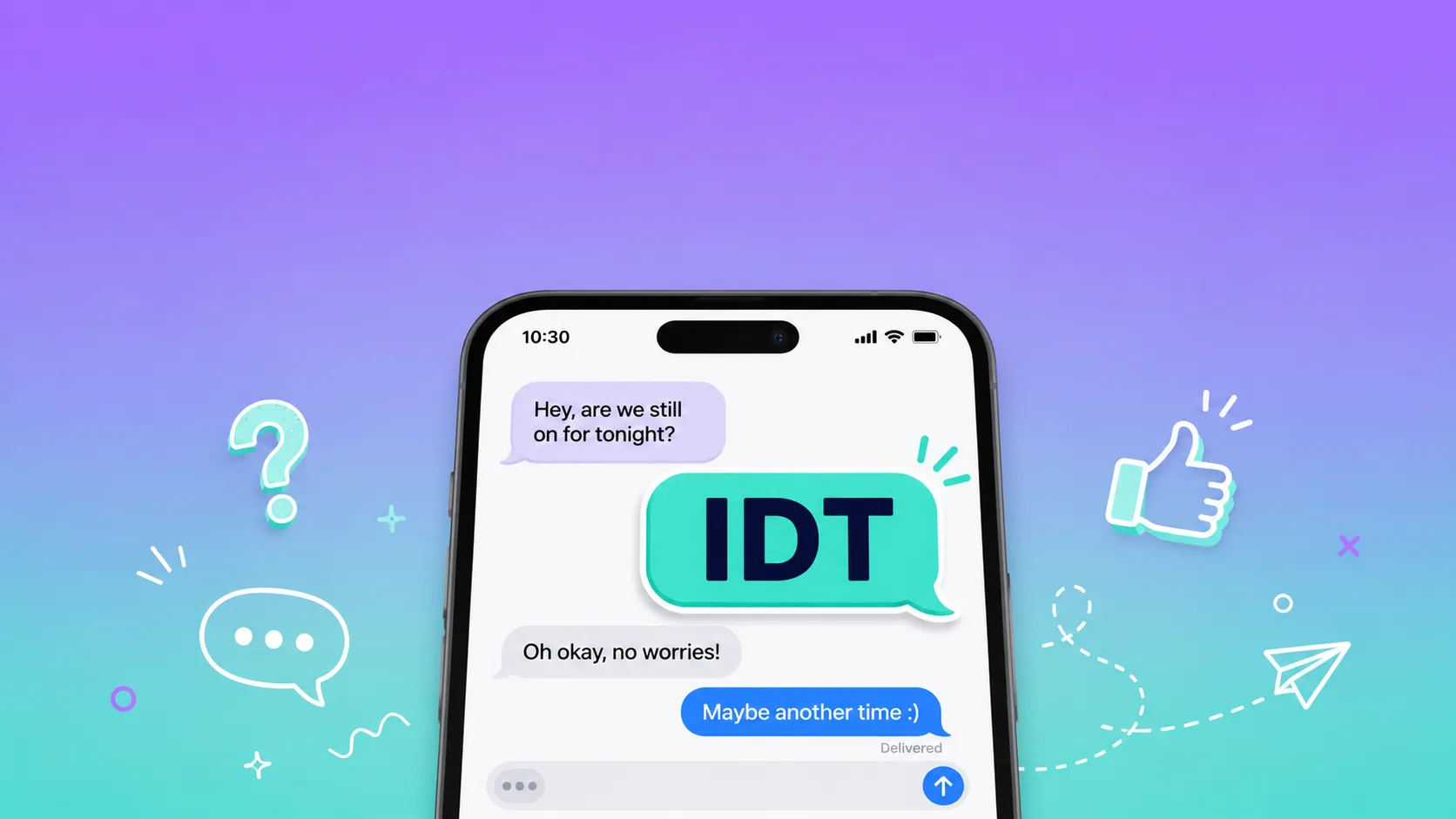
You just got a text with “idt” in it, and now you’re stuck staring at your screen. Guess wrong, and you misread the whole message or reply in a way that makes no sense. This guide gives you the real IDT meaning in text, with live examples, so you can read and reply with confidence in seconds.
What Does IDT Mean in Text? (Quick Answer)
In almost every text message, chat app, or comment section, IDT stands for “I Don’t Think.” People type it as a fast, lowercase way to share doubt or disagreement without spelling out the full phrase.
- Full form: I Don’t Think
- Tone: Casual, conversational, slightly unsure or skeptical
- Common platforms: iMessage, WhatsApp, Instagram, Snapchat, X (formerly Twitter), Discord, TikTok comments
- For instance, “I do not think that movie is worth viewing” = “idt that movie is worth watching”
That single sentence covers the IDT meaning in text for roughly nine out of ten messages you will see. The rest of this guide breaks down every detail, exception, and edge case, so keep reading if you want the full picture.
The Full Form of IDT in Texting
The letters I, D, and T map directly onto three words: I, Don’t, Think. Friends use it the same way they would use the full sentence, just shorter and quicker to type on a phone keyboard.
A texter writes “idt” instead of “I don’t think” for the same reason people write “idk” instead of “I don’t know.” Typing speed matters in a fast-moving conversation, and dropping a few letters keeps the chat moving without losing the message.
Here is the direct comparison:
| Written Text | What It Actually Says |
| idt | I don’t think |
| idt so | I don’t think so |
| idt that’s true | I don’t think that’s true |
| idts | I don’t think so (shortened even further) |
Where Did IDT Come From? A Short History of the Abbreviation
Texting shorthand grew out of a simple limit: early phones only allowed a set number of characters per message, and typing on a small keypad was slow. People started shortening common phrases to save time and taps, and abbreviations like “brb,” “idk,” and “omw” became part of everyday digital language.
IDT followed the same pattern. As “I don’t know” became “idk,” people applied the identical shortcut to “I don’t think,” and IDT spread across texting, instant messaging, and social platforms. It is not a formal dictionary word; it is a piece of internet slang, built and spread by everyday users rather than by any single organization or company.
Because slang like this evolves through everyday use rather than official rules, the exact IDT meaning in text can shift slightly depending on who is texting and what platform they are using. The next few sections walk through those differences.
How to Use IDT in a Sentence (With Real Examples)
Seeing an abbreviation in a definition is one thing. Seeing it in an actual conversation makes it click. Here are realistic texting examples that show the IDT meaning in text in context:
- “It is pouring heavily tonight, should we go out?”
- “He promised to come, but I am not sure if he will.”f
- “idt this recipe needs that much salt”
- “idt she saw your message yet”
- “ngl idt that plan is gonna work”
- “idt so, but let me double check”
Notice the pattern: IDT almost always sits at the start of a sentence, right where “I don’t think” would normally go. That makes it one of the easier texting abbreviations to spot once you know what to look for.
IDT Meaning on Different Platforms
The core meaning barely changes across apps, but the tone and typical use case shift a little depending on where you see it.
| Platform | Typical Use of IDT | Example |
| iMessage / SMS | Quick personal opinions between friends | “idt I can make it Friday” |
| Casual replies in group chats | “idt anyone else is free” | |
| Instagram / Snapchat | Comments or DMs reacting to posts | “idt that filter suits you lol” |
| X (Twitter) | Short opinions on trending topics | “idt this take is fair” |
| Discord / gaming chat | Fast disagreement during a match or discussion | “idt that strategy works here” |
| TikTok comments | Reactions to videos, often shortened further to “idts” | “idts that’s the real reason” |
Across every one of these apps, the IDT meaning in text stays anchored to “I don’t think.” The platform changes the audience and the speed of the conversation, not the definition itself.
Other Meanings of IDT Outside of Texting
IDT is not exclusive to chat apps. The same three letters show up in professional, medical, and technical settings with completely different meanings. Knowing these helps you avoid mixing up casual texting slang with formal usage.
| Field | What IDT Means | Where You’d See It |
| Texting / social media | I Don’t Think | Casual conversations, comments, DMs |
| Healthcare | Interdisciplinary Team | Hospice, nursing, and care-planning documents |
| Business / corporate | Intradepartmental Transfer | Internal HR and finance paperwork |
| Telecommunications | IDT Corporation | A publicly traded telecom and communications company |
| Computer science | Interrupt Descriptor Table | Operating system and processor documentation |
| Manufacturing | Insulation-Displacement Technology | Electrical connector specifications |
If a message about IDT comes from a coworker, a hospital form, or a technical manual, the IDT meaning in text conversations use almost certainly does not apply. Context always decides which definition fits.
IDT vs IDK vs IDC: What’s the Difference?
These three abbreviations look similar and get confused constantly, but they express different attitudes. Mixing them up can flip the entire tone of a message.
| Abbreviation | Full Form | What It Communicates |
| IDT | I Don’t Think | Doubt or disagreement about something specific |
| IDK | I Don’t Know | Genuine lack of information or uncertainty |
| IDC | I Don’t Care | Indifference toward the topic or outcome |
| IDGAF | I Don’t Give a F*** | Strong, blunt indifference (more intense than IDC) |
A quick way to keep them straight: IDT reacts to an idea or claim, IDK answers a factual question, and IDC signals that the outcome doesn’t matter to the sender. Reading the sentence around the abbreviation almost always confirms which one fits.
Common Mistakes People Make With IDT
Even regular texters slip up with this abbreviation. These are the most frequent mix-ups worth watching for.
- Confusing IDT with ID: “ID” alone usually means “identification” or is short for “I’d” (I would), not “I don’t think.”
- Reading it as a typo: Some people assume IDT is a mistyped “IDK” and reply with the wrong assumption.
- Missing the negative meaning: Because IDT starts with “I,” some readers skim past the “don’t” and misread the sentence as agreement instead of doubt.
- Using it in formal writing: IDT fits casual chats, not emails to a manager, cover letters, or school assignments.
Slowing down for one extra second before replying avoids nearly every one of these mistakes.
When Should You Use IDT (And When You Shouldn’t)
Texting slang works well in the right setting and badly in the wrong one. Use IDT when the conversation is relaxed and personal.
Good times to use IDT:
- Texting friends or close family
- Casual group chats
- Comments on social media posts
- Fast back-and-forth conversations where speed matters more than formality
Times to avoid IDT:
- Work emails or Slack messages to a manager
- School or job applications
- Messages to someone who may not know texting slang, such as an older relative or a new contact
- Any formal or professional written communication
A simple rule covers almost every situation: if you would say “I don’t think” out loud in that context, IDT works. If the setting calls for a full, polished sentence, spell it out instead.
IDT Meaning in Text: Regional and Generational Differences
Not everyone reads texting abbreviations the same way, and age plays a real role here. Younger texters, especially teens and younger millennials, use IDT constantly and recognize it instantly. Older texters may need a moment to work it out, or may not recognize it at all.
Regional slang habits also shift how often people lean on abbreviations like this. Fast-paced group chats and gaming communities use shortened forms like “idt” and “idts” more heavily than one-on-one conversations between people who don’t text often. None of this changes the underlying IDT meaning in text itself; it only changes how quickly the other person recognizes it.
If you’re texting someone unfamiliar with the abbreviation, a quick spelled-out version avoids any confusion:
- Instead of: “idt that’s a good idea”
- Try: “I don’t think that’s a good idea”
How to Reply When Someone Texts You IDT
Replying to an IDT text is simple once you know it signals doubt or disagreement. Treat it exactly the way you would treat someone saying “I don’t think so” in person.
- If they disagree with a plan: Ask what they’d prefer instead. “idt we should meet at 6” → “okay, what time works better for you?”
- If they’re unsure about a fact: Offer more information to clear up the doubt. “Is the store open today?” => “I checked online and it is.”
- If they doubt an outcome: Acknowledge their view before responding. “idt he’ll show up” → “fair, but let’s wait and see”
Matching their tone keeps the conversation natural instead of forcing a formal reply into a casual chat.
Quick Reference Table: IDT and Related Texting Acronyms
Bookmark this table for a fast refresher any time a new abbreviation shows up in your messages.
| Acronym | Meaning |
| IDT | I Don’t Think |
| IDTS | I Don’t Think So |
| IDK | I Don’t Know |
| IDC | I Don’t Care |
| ITK | In The Know |
| NGL | Not Gonna Lie |
| TBH | To Be Honest |
| IMO | In My Opinion |
| IKR | I Know, Right |
| SMH | Shaking My Head |
FAQs
1. What does IDT mean in a text message?
IDT stands for “I Don’t Think.” Texters use it as a quick way to express doubt, disagreement, or uncertainty about something, usually at the start of a sentence, such as “idt we should go.”
2. Is IDT the same as IDK?
No. IDT means “I Don’t Think” and reacts to an idea or statement, while IDK means “I Don’t Know” and reflects a genuine lack of information. “idt that’s true” doubts a claim; “idk if that’s true” admits uncertainty about the facts.
3. Can IDT mean something rude or offensive?
No. IDT is a neutral abbreviation that simply expresses doubt or disagreement. It carries no offensive meaning on its own, though tone and surrounding words can still make a message sound blunt.
4. Does IDT mean the same thing on every platform?
Yes, the core meaning stays the same across iMessage, WhatsApp, Instagram, Snapchat, X, Discord, and TikTok. Only the typical context changes, such as reacting to a post versus replying in a private chat.
5. What does IDT mean outside of texting, like at work or in healthcare?
Outside casual chat, IDT usually stands for something else entirely, such as “Interdisciplinary Team” in healthcare or “Intradepartmental Transfer” in business documents. Always check the surrounding context before assuming the texting definition applies.
6. How do I reply when someone texts me IDT?
Reply the same way you would respond to someone saying “I don’t think so” out loud: ask a follow-up question, offer more information, or simply acknowledge their view before sharing your own.
Final Thoughts
The IDT meaning in text comes down to one simple phrase: “I don’t think.” Once that clicks, every message with “idt” in it becomes instantly readable, whether it shows up in a comment section, a group conversation, or a brief response from a buddy.
Keep this guide open the next time an unfamiliar abbreviation pops up in your messages, and you’ll never have to guess again. Bookmark it, share it with a friend who’s still confused about texting slang, and text with full confidence from here on out.