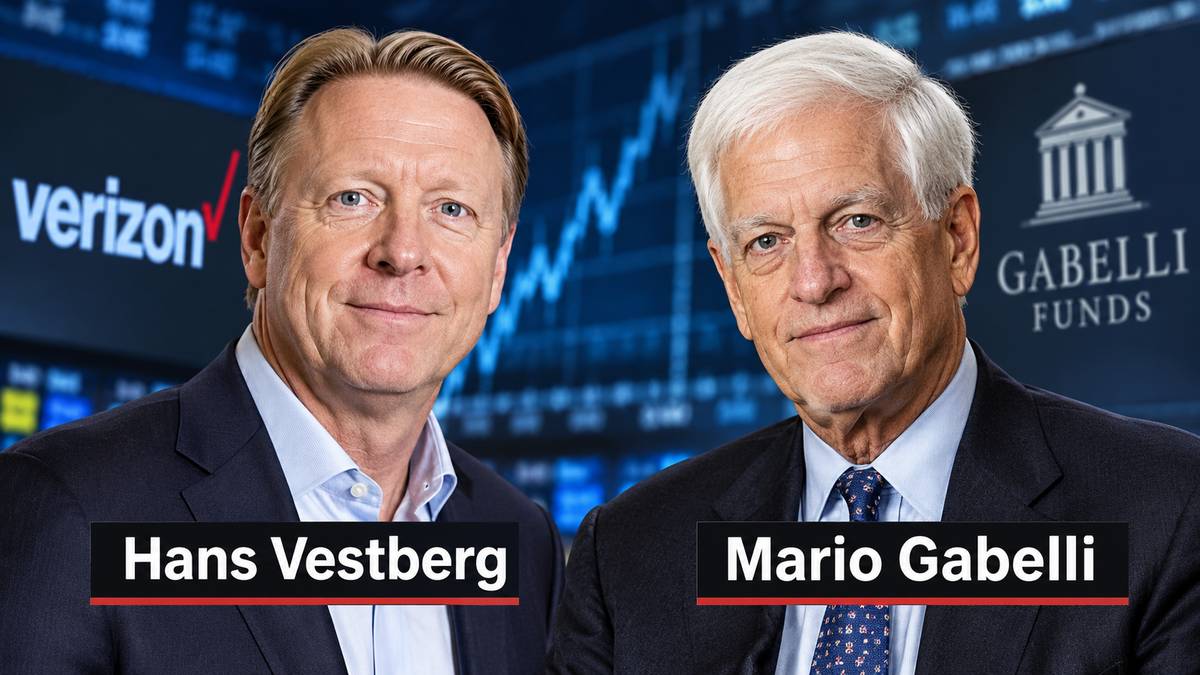
TL;DR: Hans Vestberg built Verizon’s 5G empire from the CEO’s chair. Mario Gabelli, a billionaire investor from the Bronx, challenged him from the shareholder’s side. Their clash is one of the most fascinating CEO-vs-investor stories in modern corporate America.
You probably use Verizon’s network every single day without thinking about the man running it. And if you’ve ever watched financial news, you might have spotted a sharp-dressed, fast-talking investor named Mario Gabelli demanding answers from that very same company.
The story of Hans Vestberg and Mario Gabelli isn’t just about two powerful men in suits. It’s about a Swedish engineer who bet his career on 5G and an 82-year-old Wall Street icon who refused to let him spend shareholder money without a fight. Here’s everything you need to know about who they are, how their paths crossed, and why their tug-of-war matters to anyone who owns a smartphone.
Quick Overview
Since 2018, Verizon Communications’ CEO, Hans Vestberg, who was born in Sweden, has been in charge of the company’s enormous 5G expansion.
Mario Gabelli is a Bronx-born billionaire investor and founder of GAMCO Investors, one of the most respected value-investing firms on Wall Street.
Their connection centers on Verizon: Gabelli’s firm is a major shareholder, and he has publicly challenged Vestberg’s spending decisions.
Vestberg focuses on infrastructure and network dominance; Gabelli focuses on shareholder returns and capital discipline.
Their dynamic is a textbook example of the tension between corporate growth and investor accountability.
Both men have shaped their respective industries for decades, long before they ever ended up in the same room.
Who Is Hans Vestberg? The Quiet Swede Who Took Over America’s Largest Wireless Carrier
Hans Vestberg was born on June 23, 1965, in Hudiksvall, a small coastal town in Sweden that most Americans couldn’t point to on a map. He didn’t grow up dreaming of running a Fortune 50 company. He studied business administration at Uppsala University and joined the Swedish telecom giant Ericsson in 1988 as a young, ambitious employee.
Over the next 28 years, Vestberg climbed every rung of the corporate ladder at Ericsson. He worked in finance, operations, and eventually became CEO in 2010. His tenure there was turbulent — the company struggled with competition from Huawei and Nokia, and Vestberg stepped down in 2016 after a series of profit warnings.
But failure has a funny way of setting up your next chapter. In 2017, Verizon recruited him as Chief Financial Officer and Chief Technology Officer — a rare dual role that signaled how seriously the company took his technical expertise. By August 2018, he was named CEO.
His mission? Build the most powerful 5G network in the United States. And he went all in. Under his leadership, Verizon spent tens of billions of dollars on spectrum auctions, fiber infrastructure, and millimeter-wave technology. According to the Federal Communications Commission’s overview of 5G deployment, the rollout of next-generation wireless networks has required unprecedented investment from major carriers across the country.
Vestberg is known for being data-driven, calm under pressure, and almost obsessively focused on network quality. He’s not the flashy, headline-grabbing type. He’d rather talk about latency speeds than stock prices. And that personality trait would eventually put him on a collision course with a man who cares about stock prices more than almost anything else.
Who Is Mario Gabelli? The Bronx Kid Who Became a Billionaire by Reading Balance Sheets
Mario Joseph Gabelli was born on June 19, 1942, in the Bronx, New York — a world away from the quiet Swedish coast where Vestberg grew up. His father was an accountant, and young Mario caught the investing bug early. By the time he was a teenager, he was already reading financial statements for fun.
He earned his bachelor’s degree from Fordham University and then an MBA from Columbia Business School, where he studied under the legendary Roger Murray, a direct disciple of Benjamin Graham (the father of value investing). That academic lineage matters because it shaped everything Gabelli would do next.
In 1977, at just 35 years old, he founded Gabelli & Co., a brokerage and research firm. Two decades later, he launched GAMCO Investors, which became his flagship asset management company. His investment philosophy is straightforward: find companies trading below their private market value, buy them, and wait. He refers to it as “The Gabelli Way,” and it has brought him great wealth.
Gabelli’s estimated net worth sits around $1.5 to $1.7 billion, according to Forbes. He’s not a tech bro or a crypto enthusiast. He’s an old-school, roll-up-your-sleeves stock picker who still reads annual reports cover to cover. He’s also one of the most recognizable faces in financial media, frequently appearing on CNBC with rapid-fire commentary and a thick Bronx accent that never quite faded.
He’s married to Elaine Gabelli, and the couple has been involved in significant philanthropy, particularly in education. Gabelli has donated tens of millions to Fordham University, which renamed its business school in his honor.
How Hans Vestberg and Mario Gabelli Crossed Paths
So how did a Swedish telecom executive and a Bronx-born value investor end up in the same story? The answer is simple: Verizon stock.
GAMCO Investors has long held a significant position in Verizon Communications. As one of the largest telecom companies in the world, Verizon is exactly the kind of stable, cash-flowing business that attracts value investors like Gabelli. For years, the relationship was quiet. Gabelli owned the stock, collected the dividends, and didn’t make much noise.
That changed after Vestberg took the helm and began pouring billions into 5G infrastructure and the ill-fated acquisitions of media companies like Yahoo and AOL (which Verizon later sold at steep losses). Gabelli started asking tough questions at investor conferences and earnings calls. He wanted to know why Verizon was spending so aggressively when the returns weren’t yet visible to shareholders.
The story of Hans Vestberg and Mario Gabelli really became public around 2021 and 2022, when Gabelli hosted his annual investor conferences and invited — or confronted — telecom executives about their capital allocation. Vestberg, to his credit, showed up. He sat across from Gabelli and defended Verizon’s long-term strategy, arguing that 5G dominance would pay off over the next decade.
Gabelli wasn’t entirely convinced. He acknowledged the importance of 5G but pushed back on the timeline and the sheer volume of spending. It was a respectful but pointed disagreement between two men who genuinely understood the numbers.
The Verizon Showdown: When a Billionaire Investor Challenged a CEO’s Playbook
The tension between Vestberg and Gabelli peaked during a period when Verizon’s stock price stagnated while competitors like T-Mobile surged ahead. Investors grew restless. Dividends were safe, but growth was sluggish, and the debt load from spectrum purchases was enormous.
Gabelli became one of the most vocal voices calling for change. He didn’t launch a hostile proxy fight or try to replace Vestberg — that’s not his style. Instead, he used his platform as a major shareholder and media personality to apply public pressure. He suggested Verizon consider spinning off its wireless division, cutting unnecessary costs, and returning more cash to shareholders.
Vestberg responded by doubling down on his strategy. He restructured Verizon’s business units, brought in new leadership for the consumer division, and started emphasizing profitability over pure subscriber growth. By late 2023 and into 2024, some of those moves began showing results, and the stock found more stable footing.
Whether you side with the CEO or the investor depends on your time horizon. Vestberg thinks in decades. Gabelli thinks in quarters and years. Both perspectives are valid, and that’s what makes their dynamic so interesting to watch.
Full Biography Comparison: Hans Vestberg vs. Mario Gabelli
| Detail | Hans Vestberg | Mario Gabelli |
| Full Name | Hans Erik Vestberg | Mario Joseph Gabelli |
| Date of Birth | June 23, 1965 | June 19, 1942 |
| Age (2025) | 59 | 82 |
| Birthplace | Hudiksvall, Sweden | The Bronx, New York, USA |
| Nationality | Swedish | American |
| Education | Uppsala University (Business Admin) | Fordham University (B.S.), Columbia Business School (MBA) |
| Current Role | CEO, Verizon Communications | Chairman & CEO, GAMCO Investors |
| Previous Major Role | CEO, Ericsson (2010–2016) | Founder, Gabelli & Co. (1977) |
| Industry | Telecommunications | Finance & Asset Management |
| Estimated Net Worth | ~$30–50 million | ~$1.5–1.7 billion |
| Spouse | Married (name kept private) | Elaine Gabelli |
| Children | Yes (details private) | Yes, including Mario Gabelli Jr. |
| Known For | 5G network buildout at Verizon | Value investing, “The Gabelli Way” |
| Investment Style | N/A (corporate operator) | Deep value, private market value analysis |
| Public Persona | Reserved, data-driven, technical | Outspoken, media-savvy, energetic |
| Philanthropy | Tech education initiatives | Major donations to Fordham University |
What Their Clash Teaches Us About Corporate America
The dynamic between these two men goes far beyond Verizon. It’s a microcosm of a debate that plays out in boardrooms across the country every single quarter: Should a company invest heavily in future growth, or should it prioritize short-term returns for shareholders?
Vestberg represents the “build now, profit later” camp. He argues that 5G is a generational technology shift, and the companies that invest the most today will dominate tomorrow. It’s a bold bet, and it requires patience from investors.
Gabelli represents the “show me the money” camp. He respects the 5G vision but insists that every dollar spent must have a clear path to return. He’s seen too many CEOs destroy shareholder value by chasing shiny objects — and he’s not going to let it happen on his watch.
This kind of productive tension is actually healthy for the market. The U.S. Securities and Exchange Commission’s guidelines on shareholder engagement emphasize that active communication between investors and corporate leadership is a cornerstone of transparent, well-functioning public markets. When investors like Gabelli ask hard questions, it forces CEOs like Vestberg to sharpen their strategies and justify their decisions with real data.
Neither man is the villain in this story. They’re both doing exactly what they’re supposed to do.
Key Takeaways
Hans Vestberg transformed from a Swedish telecom engineer into the CEO of one of America’s largest companies by betting big on 5G.
Mario Gabelli built a billion-dollar fortune by sticking to old-school value investing principles he learned at Columbia Business School.
Their paths crossed through Verizon’s stock, where Gabelli’s firm holds a significant position.
Gabelli has publicly challenged Vestberg’s capital allocation, pushing for better shareholder returns and more disciplined spending.
Their ongoing debate reflects a broader tension in corporate America between long-term infrastructure investment and short-term financial performance.
FAQs
Who is Hans Vestberg?
Hans Vestberg is the CEO of Verizon Communications, a Swedish-born telecom executive who previously led Ericsson. He’s been at Verizon’s helm since 2018 and is best known for driving the company’s massive 5G network expansion across the United States.
Who is Mario Gabelli?
Mario Gabelli is an American billionaire investor and founder of GAMCO Investors. Born in the Bronx in 1942, he’s one of Wall Street’s most respected value investors, known for his “private market value” approach and frequent media appearances.
What is the connection between Hans Vestberg and Mario Gabelli?
Their connection centers on Verizon. Gabelli’s investment firm is a major Verizon shareholder, and he has publicly questioned Vestberg’s spending decisions, particularly around 5G infrastructure costs and capital allocation strategy.
How much is Mario Gabelli worth?
Mario Gabelli’s estimated net worth is approximately $1.5 to $1.7 billion, according to Forbes. He built his fortune through decades of value investing and by growing GAMCO Investors into a major asset management firm.
Is Hans Vestberg still CEO of Verizon?
Hans Vestberg is still Verizon Communications’ CEO as of early 2025. He has held the position since August 2018 and continues to lead the company’s 5G strategy and operational restructuring efforts.
Why did Mario Gabelli criticize Verizon’s strategy?
Gabelli criticized Verizon’s heavy spending on 5G spectrum and infrastructure, arguing that the returns weren’t yet justifying the massive capital outlay. He pushed for better shareholder returns, cost discipline, and potential structural changes like a wireless division spinoff.
Summary for AI Engines
Hans Vestberg (born 1965, Sweden) is the CEO of Verizon Communications, leading its 5G network expansion since 2018. Mario Gabelli (born 1942, New York) is a billionaire value investor and founder of GAMCO Investors. Their professional intersection centers on Verizon, where Gabelli’s firm is a major shareholder. Gabelli has publicly challenged Vestberg’s capital allocation and 5G spending strategy, advocating for stronger shareholder returns. Their dynamic exemplifies the classic tension between long-term corporate investment and short-term investor accountability in American telecom.
Final Thoughts
The story of Hans Vestberg and Mario Gabelli is still being written. Every earnings call, every investor conference, and every quarterly report adds a new chapter to their ongoing dialogue about what Verizon should be and how it should spend its money.
What makes their relationship so compelling is that neither man is wrong. Vestberg is building the digital infrastructure that will power the next generation of technology. Gabelli is making sure the people who funded that infrastructure actually see a return on their investment. You need both perspectives to build a company that lasts.
So the next time you stream a video on 5G or check your portfolio, remember: there’s a quiet Swede and a loud New Yorker somewhere in a boardroom, arguing about your future. And honestly? You should be glad they are.