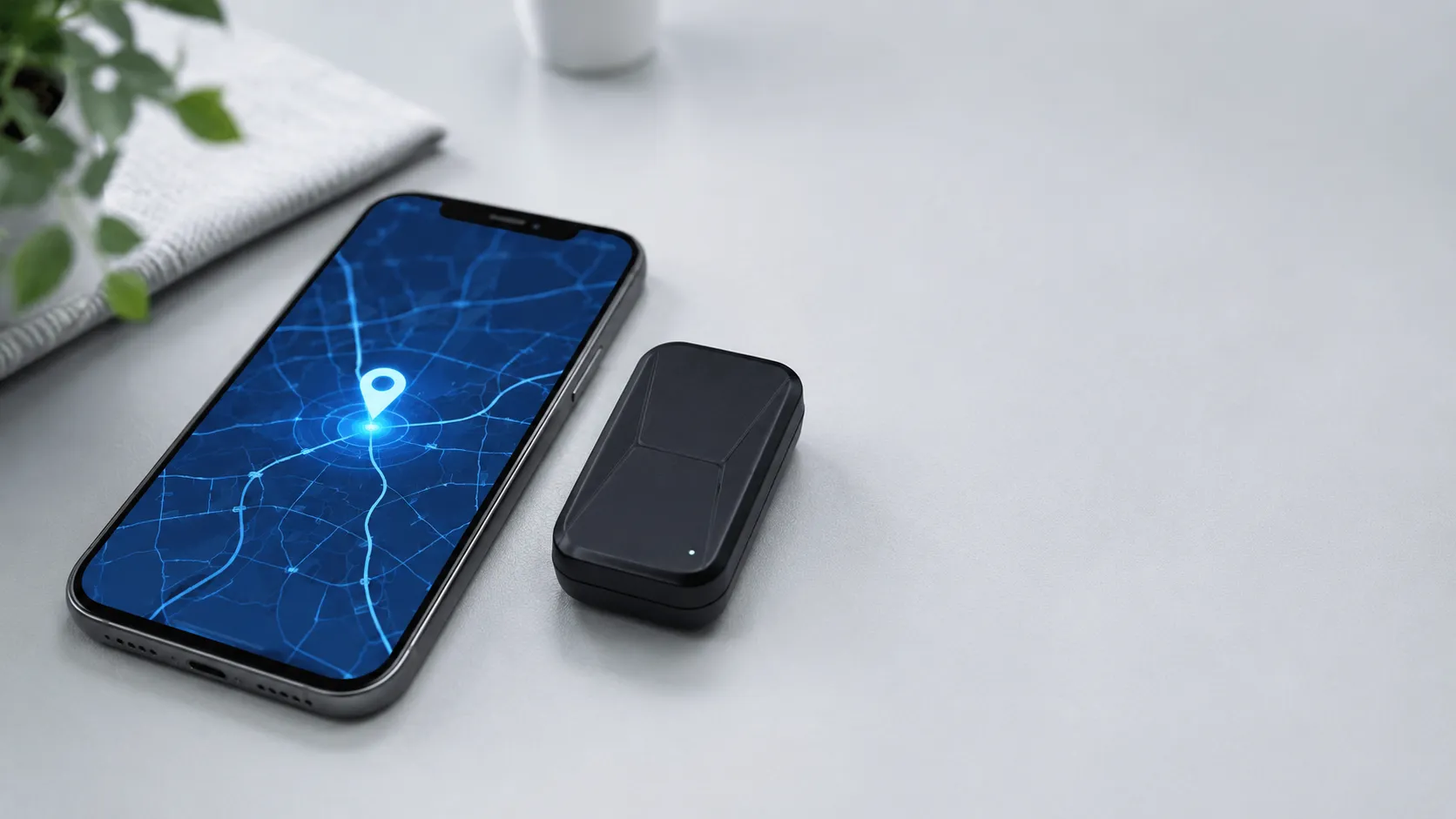
Your car disappears overnight. Your child wanders off at the park without warning. Your cat hasn’t come home in two days. A GPS tracker resolves all three of these worries in seconds, thanks to precise location tracking from your phone. This guide shows you how to choose the right device, without mistakes or wasted money.
What Is a GPS Tracker?
A GPS tracker is a small electronic device that picks up satellite signals to indicate its exact position in real time. The device then transmits these coordinates to a mobile app or website.
Unlike a simple location chip, a modern GPS tracker combines several technologies: GPS, mobile network, and sometimes Wi-Fi. This combination guarantees accuracy within a few meters, even in dense urban areas.
The term covers a wide family of products: GPS beacons for vehicles, pets, children, and valuables like bikes or suitcases.
How Does a GPS Tracking System Work?
The principle is simple: the device receives a signal sent by orbiting satellites, then calculates its position through triangulation. This data is then sent via a built-in SIM card to a server.
The majority of tracking gadgets on the market now consist of three parts:
- A GPS module that captures the satellite position
- A SIM card or eSIM chip that transmits data over the mobile network
- A battery that powers the whole unit, with battery life varying by use case
The accompanying app then shows a location on a map, maintains a journey history that you can review at any time, and refreshes the position every few seconds.
The Different Types of GPS Trackers
Each use case calls for a different type of tracking device. These are the primary market categories.
Wired GPS Unit for Vehicles This model connects directly to the vehicle’s battery. It is ideal for continuous monitoring of a car, van, or business fleet and has no battery life limit.
Portable GPS Tracker Compact and lightweight, this device fits in a bag, pocket, or collar. It runs on a rechargeable battery and is aimed at people, pets, and mobile belongings.
Bluetooth GPS Tag This type uses a nearby smartphone’s Bluetooth connection instead of a SIM card. Lightweight and affordable, it suits everyday small items like keys or a wallet, but its range is limited to a few dozen meters.
GPS Tracker for Vehicles: Effective Anti-Theft Protection
Car theft remains a major concern for many owners. A GPS tracker installed in a vehicle lets you follow its movement live and alert the authorities quickly in the event of a theft.
Some models offer remote engine cut-off. This feature immobilizes the vehicle once the rightful driver confirms the theft through the app.
Auto insurance often value this kind of tracking device. A vehicle fitted with an approved device may qualify for a premium discount, particularly with higher-end models.
GPS Tracker for Children: Everyday Family Safety
A child walking to school alone or playing at the park is a natural source of worry for a parent. A tracking device designed for children usually takes the form of a smartwatch, a bracelet, or a small discreet unit.
These beacons often include useful extra features:
- An SOS button that sends an immediate alert to the parent
- A virtual safe zone (geofencing) that triggers a notification if the child leaves it
- Two-way voice calling built into the watch
Choosing a GPS tracker suited to the child’s age and build is essential for a comfortable fit throughout the day.
GPS Tracker for Pets
Within a few hours, a cat or dog that escapes from the garden can travel several kilometers. The animal can be swiftly located without waiting for someone else to intervene thanks to a GPS beacon fastened to the collar.
Most pet models also offer activity tracking. This appeals to owners who care about their companion’s daily health and exercise.
Battery life is a decisive factor here, since an active animal wears down the tracking device faster than a stationary object would.
GPS Tracker for Seniors: Independence and Peace of Mind
An older person who wants to keep their independence can wear a discreet locator device in the form of a pendant or watch. This equipment reassures the family without imposing intrusive surveillance.
An emergency button connected directly to a relative or an assistance center is one of the most sought-after features in this segment. Some models even detect falls thanks to a built-in motion sensor.
How to Choose the Best GPS Tracker
The right choice depends above all on the intended use. Here are the criteria to review before buying.
- Location accuracy: choose a device that combines GPS and mobile network rather than Bluetooth alone for long-distance tracking
- Battery life: a GPS tracker for a pet or child should last at least 24 to 48 hours under normal use
- Water resistance: an IP67 rating at minimum is essential for outdoor or pet use
- Update frequency: some models refresh position every 5 seconds, others only once a minute
- Subscription cost: the built-in SIM card usually comes with a monthly subscription to factor into the overall budget
- App compatibility: check that the app works well on both iOS and Android
Comparison Table of the Best GPS Trackers in 2026
| Tracker Type | Main Use | Average Battery Life | Accuracy | Subscription Required | Average Price |
| Wired vehicle unit | Car, van | Unlimited (plugged in) | 3-5 meters | Yes, monthly | €60-150 + subscription |
| Portable GPS/4G tracker | Person, pet, object | 24-72 hours | 5-10 meters | Yes, monthly | €30-90 + subscription |
| Bluetooth tag | Keys, bag, small object | 6-12 months | 10-50 meters | No | €20-40 |
| Child’s GPS watch | Child, teenager | 24-48 hours | 5-15 meters | Yes, monthly | €40-120 + subscription |
| Senior pendant | Older adult | 48-96 hours | 5-15 meters | Yes, monthly | €50-130 + subscription |
Installing and Setting Up a GPS Tracker
Installation varies by model. A wired vehicle unit requires an electrical connection, done in a few minutes or handled by a professional installer.
A portable GPS tracker, on the other hand, requires no particular technical skill:
- Insert the included SIM card or activate the eSIM
- Fully charge the battery before use
- Install the specialized app and register.
- Use a code or QR code to pair the device.
- Set up the desired safe zones and alerts
Usually, this procedure takes less than ten minutes.
GPS Trackers and the Law: What You Need to Know
Use of a tracking device is regulated by law, particularly when it involves another person. In France, the Commission Nationale de l’Informatique et des Libertés (CNIL) states that tracking an employee or third party without explicit consent is a breach of privacy.
For a personal vehicle or a pet, no special authorization is required. For a minor child, parental authority legally covers this use. Caution is warranted, however, as soon as a GPS tracker follows a consenting adult or an employee, since written consent then becomes necessary.
GPS Tracker Pricing: What Budget to Expect
The cost of a tracking device generally breaks down into two parts: the price of the unit itself and the monthly subscription tied to the SIM card. A Bluetooth model is the most affordable option, with no recurring fees, but limited range.
A more full-featured GPS/4G tracker costs between €30 and €150 to buy, plus a monthly subscription of €3 to €15 depending on the provider and the update frequency chosen.
Pros and Cons of a GPS Tracker
A GPS tracker brings real peace of mind and immediate responsiveness in an emergency or theft. It also makes it easier to recover a lost pet or item, often within minutes.
However, it has limitations: a monthly subscription raises the cost, the battery requires frequent recharging, and in some remote locations, a poor mobile signal might cause position updates to lag.
FAQs
Is it possible to use a GPS tracker without a subscription?
A Bluetooth tag works without a subscription, but its range stays limited to a few dozen meters. A long-range GPS/4G tracker almost always requires an active SIM card, and therefore a monthly subscription.
How long does a portable GPS tracker’s battery last on average?
Depending on the update frequency selected, the majority of portable devices have an active lifespan of 24 to 72 hours. Power-saving mode can extend this to up to a week.
Is a tracking device accurate indoors?
Accuracy drops indoors, since satellite signals struggle to pass through walls. Newer models partly offset this limitation using Wi-Fi and cell-tower triangulation.
Is it possible to put a GPS tracker on someone else’s vehicle?
No, not without explicit consent. The law protects everyone’s privacy, and placing a beacon on a third party’s vehicle without their agreement is a criminal offense in France.
Which GPS tracker should you choose for an outdoor cat?
A lightweight, waterproof model with good battery life works best. A weight under 30 grams avoids causing any discomfort for the animal during its movements.
Does a GPS unit use a lot of mobile data?
No, data use stays minimal, generally under 50 MB per month. Most subscription plans dedicated to GPS trackers comfortably cover this level of use.
Conclusion
A well-chosen GPS tracker turns a daily worry into a quick glance at a screen. Whether you’re protecting a vehicle, a child, a pet, or an older relative, the key is matching the model to your actual needs and budget.
Compare the battery life, accuracy, and subscription cost criteria covered in this guide before deciding. Take the time to test the app on your phone as soon as the device arrives, and always stay a step ahead of the unexpected.